
Bowman Draft vs. Bowman Chrome vs Bowman Baseball: What’s the Difference?
Compare Bowman Draft, Bowman Chrome, and Bowman Baseball. Learn each release’s purpose, prospect focus, card formats, and how to identify your cards correctly.
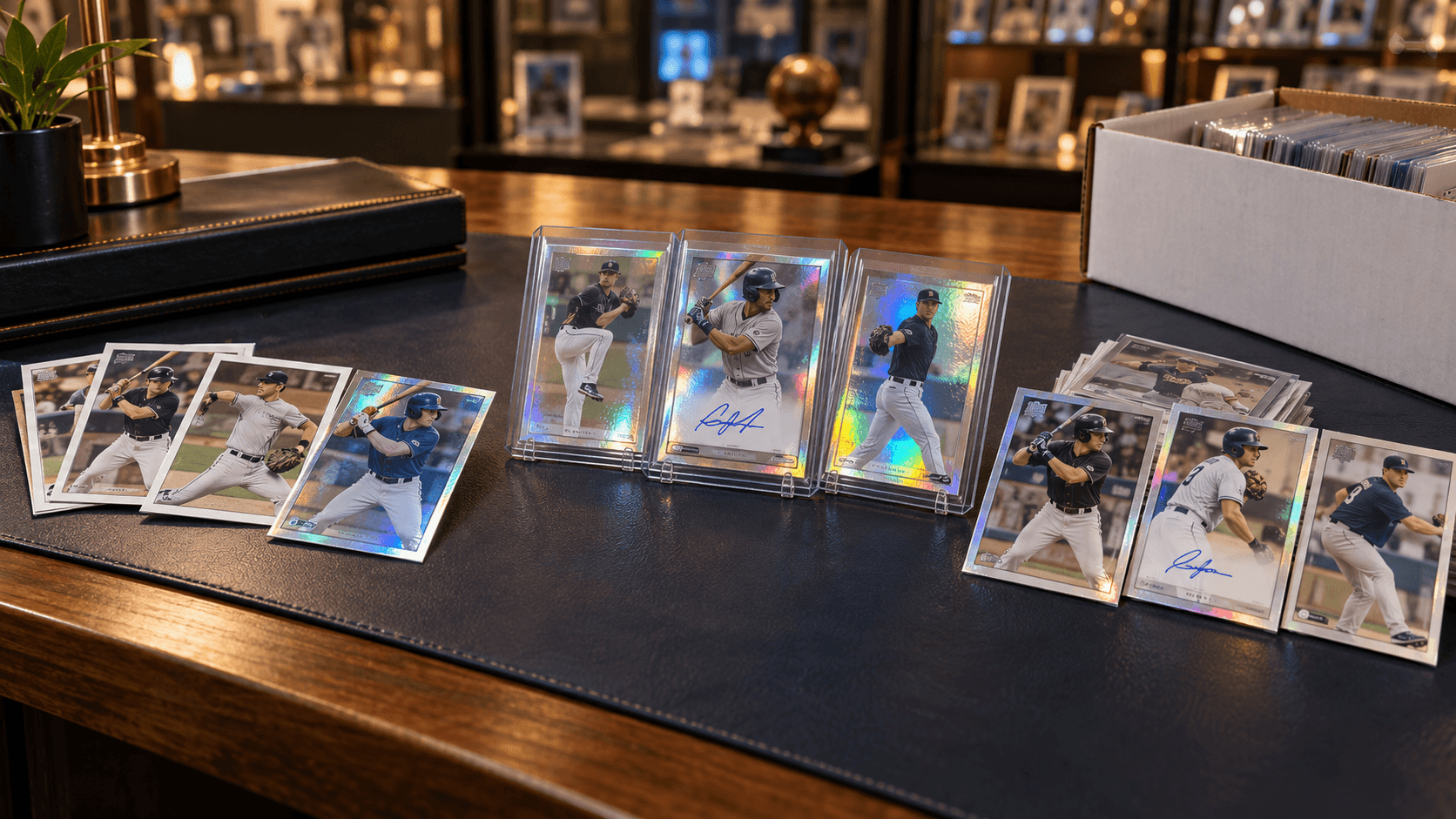
Bowman Baseball opens the main Bowman prospecting cycle with a mix of MLB players and prospects. Bowman Chrome follows with a standalone chromium release that places particular emphasis on international talent. Bowman Draft centers on the MLB draft class and other developing prospects, with paper and Chrome cards.
The confusing part is that a Chrome card can come from all three products. Finding “Bowman Chrome” on a card does not, on its own, tell you which release it belongs to.
For collectors learning how trading card releases work, these products show why brand, release, checklist, and finish need separate attention. This guide compares their purpose, explains where 1st Bowman cards fit, and shows how to identify a card before comparing its value.
What’s the Difference Between the Three Bowman Releases?
Think of the main Bowman lineup as three connected chapters in prospect collecting. Each chapter introduces or revisits emerging players, but the checklist emphasis changes.
| Collector Question | Bowman Baseball | Bowman Chrome | Bowman Draft |
|---|---|---|---|
| What is its main job? | Start the main prospecting cycle | Spotlight Chrome prospects and international talent | Introduce draft-class talent |
| Who is the prospect focus? | A broad mix of emerging players | International signees and other prospects | Recent draft picks and other prospects |
| Does it also feature MLB players? | MLB veteran and rookie base cards | MLB veteran and rookie base cards | Prospect-focused core checklist |
| Does it have paper cards? | Yes | Chrome is the core format | Yes |
| Does it have Chrome cards? | Yes, including Chrome prospects | Yes, as a standalone Chrome release | Yes, including Chrome prospects |
| Can it contain 1st Bowmans? | Yes, for designated subjects | Yes, for designated subjects | Yes, for designated subjects |
| Why would I collect it? | Follow current MLB players and the next wave together | Follow international talent through Chrome cards and autos | Follow a draft class or a team’s recent picks |
| What should I avoid assuming? | “Bowman Baseball means paper only” | “Every Chrome card came from this product” | “Every card is a new draft pick or a 1st Bowman” |
These are product-level patterns. They do not promise a specific player, autograph, parallel, or box content in every edition. A trading card checklist establishes what actually belongs to the release.
The quick takeaway: Baseball starts the main cycle, Chrome emphasizes international prospect talent, and Draft centers on the draft class.
What Is Bowman Baseball Designed to Do?
Bowman Baseball is the broad entry point into the main annual Bowman lineup. It combines current Major League players with prospects whose professional stories are still developing.
Topps describes 2026 Bowman Baseball as the season’s first prospect-focused release. That edition includes a 100-card base set of MLB stars and rookies alongside a 150-card prospect set. Its Chrome prospect content also makes clear that Bowman Baseball is more than a paper-card product.
For a team collector, this creates an appealing mix: established players you already follow and younger names working toward the same roster. For a prospect collector, the attraction may be a specific new 1st Bowman rather than the veteran base set.
If you’re new to sports card collecting, identify which part of the product interests you. Building the MLB base set and collecting Chrome prospects are different projects, even though cards for both can come from the same box.
Bowman Baseball also helps explain why the product name cannot identify a card completely. A paper MLB base card, a paper prospect, and a Chrome prospect may all belong to the same release while representing separate checklist entries.
What Is Bowman Chrome Designed to Do?
Bowman Chrome is a separate release built around Chrome cards. Its prospect checklist gives international talent an important place in the Bowman collecting cycle.
International signees and MLB draft picks enter professional baseball through different routes. Bowman Chrome helps collectors follow that broader pipeline, while also including established Major League players and rookies.
The 2026 edition illustrates that structure with a 100-card MLB base set and a separate 100-card prospect set.
The international focus is an emphasis, not a rule that every subject must be an international signing. Similarly, the product is not exclusively a prospect set simply because prospect autographs attract substantial attention.
For collectors familiar with Topps Chrome, Sapphire, and related editions, keep the brand straight. Topps Chrome and Bowman Chrome are separate products.
A shared manufacturer and reflective card construction do not make their checklists interchangeable.
What Is Bowman Draft Designed to Do?
Bowman Draft concentrates on players entering the professional pipeline through the MLB Draft, alongside other prospects. It gives collectors a way to connect draft-day interest with early cards of those players.
The 2025 release illustrates that purpose with a 200-card checklist of draft picks and prospects, offered on paper and Chrome stock.
Draft is a natural place to research a recently selected college pitcher, high school shortstop, or another player your favorite team added. However, the product name does not establish that every draft pick is included or that every card carries a 1st Bowman logo.
Remember to separate product year from release date. The 2025 Bowman Draft hobby release arrived in January 2026. It remains a 2025 product when identifying the card.
That’s the same principle covered in our explanation of card sets and release structure: a release has its own identity, even when calendar timing creates confusion.
Bowman Draft vs Bowman Chrome: What Should You Compare?
The most useful comparison is the player pipeline and exact checklist, rather than which product sounds more premium.
Bowman Draft directs attention toward draft-class talent. Bowman Chrome gives international prospect collecting a major platform through a standalone Chrome release.
Both can interest collectors looking for early cards, prospect autographs, and Refractor parallels.
Before choosing between them, ask:
- Is the player on the base prospect checklist, autograph checklist, or both?
- Does the specific card carry a 1st Bowman logo?
- Which unsigned and signed versions exist?
- Which parallels belong to that exact checklist?
- Are you collecting a player, team, draft class, or type of card?
A player’s unsigned prospect appearance does not guarantee an autograph in the same product. Likewise, appearing in a later Bowman release does not automatically create another 1st Bowman.
If the player is your priority, follow the card you want to its documented release. The release name alone is too broad to guide the comparison.
Bowman Baseball vs Bowman Draft: Is One Better for Prospecting?
Both support prospect collecting. Bowman Baseball provides a broader mix, while Bowman Draft offers a more concentrated draft-class focus.
The choice depends on the collection you’re building. A collector interested in MLB stars alongside developing players may prefer Bowman Baseball’s structure. Someone following a team’s recent draft picks may find Bowman Draft more directly relevant.
Neither product automatically offers better value. A desirable card depends on its player, exact identity, availability, condition, and demand.
Our guide to why some trading cards are valuable explains why rarity alone cannot settle that question.
Prospecting also involves uncertainty. Players develop at different speeds, injuries happen, and expectations change. An early card can be a rewarding part of following a career without becoming an expensive card later.
Why Can a Bowman Chrome Card Come From Bowman Baseball or Draft?
“Chrome” has two uses in this conversation: it identifies a card format, and it appears in the name of a standalone product.
Bowman Baseball includes Chrome prospect cards. Bowman Draft also includes Chrome prospect cards. Those cards retain their relationship to the release and checklist that produced them.
This is one of the most useful things to understand before buying Bowman singles.
| Detail on the Card or Listing | What It Tells You | What It Does Not Tell You | Your Next Check |
|---|---|---|---|
| Chrome | The card uses Chrome construction | Which Bowman release produced it | Match the year and card number to the release checklist |
| 1st Bowman logo | The designated first Bowman prospect issue | That it is an official MLB rookie card | Confirm the prospect checklist entry and exact version |
| RC logo | MLB rookie-card designation | That it is the player’s earliest card | Keep it separate from earlier prospect issues |
| Refractor | A documented reflective parallel treatment | A universal print run or serial number | Verify the exact parallel for that release and year |
| Stamped 12/99 | Copy 12 of a 99-copy numbered version | That only 99 total cards of this player exist | Identify which checklist and parallel the stamp belongs to |
| Autograph | A signature is present | That it is a manufacturer-issued 1st Bowman autograph | Check the autograph checklist, certification text, and printed logo |
| Hobby, Jumbo, or Mega | Packaging or distribution context | A separate identity for every card inside | Check whether the card is a shared issue or an exclusive version |
Read the full identity together: product year + release + checklist + card number + designation + format + parallel + autograph status.
A listing that says “Bowman Chrome prospect” may be accurate but incomplete. You still need the year, card number, checklist section, and version.
Use our guide to identifying a trading card by year, set, player, and number when the listing title leaves those details unclear.
Where Do 1st Bowman Cards and Rookie Cards Fit?
A modern 1st Bowman prospect issue and an official MLB rookie card mark different stages of a player’s card history.
The 1st Bowman logo identifies the player’s designated first Bowman prospect issue. An RC-logo card belongs to the player’s Major League rookie-card stage.
A player reaching MLB does not retroactively change an earlier prospect card into an official RC.
All three main releases can contain designated 1st Bowman subjects. None gives every prospect a new first designation simply because the year or product changes.
Also, don’t assume the paper card, Chrome card, and autograph all appear together. Check each checklist category separately.
Our guide to rookie cards and why they matter explains the broader rookie-card terminology.
When organizing Bowman, record the printed designation and the checklist category rather than relying on a seller’s use of “rookie.”
How Do Refractors, Parallels, and Autographs Change the Comparison?
Once you know the release, identify the version within it.
A standard Chrome prospect card and a colored Refractor may share a player, photograph, and card number. The parallel changes a recognized attribute such as color, pattern, finish, or serial numbering.
Our explanation of parallel cards covers that relationship.
The guide to Refractor, Prizm, Chrome, and Holo terminology explains why a reflective card is not automatically a particular parallel.
A printed 12/99, for example, identifies copy 12 within that numbered version’s 99-copy run. It does not establish that only 99 cards of the player exist across the product.
Read more about serial-numbered trading cards before comparing numbered listings.
Autographs add another identity field. A manufacturer-issued prospect autograph, rookie autograph, and later signature added to an unsigned card are different things.
Our guide to base, parallel, autograph, and memorabilia card types helps separate those categories.
Do not assume that matching color names across releases mean matching print runs or odds. Confirm the specific year and checklist.
Are Inserts and Variations Part of the Same Checklist?
Not necessarily. A product can contain multiple connected checklists.
An insert card generally belongs to a separate themed set within the release. A parallel is a version of an underlying card. A recognized variation may change the photograph or another documented detail.
The comparison of base cards, inserts, and parallels explains these relationships.
Our guide to photo and image variations covers another common identification problem.
An insert featuring a young player does not become a 1st Bowman solely because it appears early in his career.
Similarly, a card described as a short print or super short print should not be assigned an invented print run.
Do Hobby, Jumbo, and Mega Boxes Change the Product?
Box configuration describes packaging and distribution. It may affect card quantities, autograph expectations, exclusive content, and odds.
It does not automatically make a shared standard card a different card.
An exclusive parallel can have a separate identity because its documented version changes, rather than simply because it came from another box.
Our comparison of hobby boxes, retail boxes, blasters, and mega boxes explains this separation.
Verify configuration-specific information for the edition you’re researching instead of carrying over last year’s contents.
Which Bowman Release Fits Your Collecting Goal?
Use this chart as a research starting point, then confirm the player and card on the checklist.
| “I Want to Collect…” | Start Your Research With | Why It Fits | Before Buying, Confirm |
|---|---|---|---|
| Current MLB stars and future players | Bowman Baseball | MLB base cards and prospect content in one release | Which base or prospect set you’re building |
| Emerging international signees | Bowman Chrome | International talent is a major prospect focus | Your player’s checklist entry and available versions |
| My team’s newest draft picks | Bowman Draft | The draft class is central to the product | Whether each target player actually appears |
| One player’s 1st Bowman | The release containing the designated issue | A player’s first issue can appear in any of the three | Printed 1st logo, card number, and format |
| A 1st Bowman Chrome autograph | That player’s exact autograph checklist | Product names alone cannot establish the signed first issue | 1st logo, autograph category, parallel, and condition |
| A complete parallel rainbow | One exact card within one release | A rainbow follows that card’s documented versions | Checklist-specific colors, patterns, and numbering |
| The same player across all three releases | Each release’s checklist separately | Related cards can document different career stages | Release, designation, image, and autograph differences |
Choose the player and card first. Then identify the release that contains it.
For anyone learning how to start collecting trading cards, a clear goal makes the lineup easier to approach.
You do not need every release to build a coherent collection.
What Mistakes Should Bowman Collectors Avoid?
- Calling every Bowman prospect card a rookie card
- Assuming every Chrome card belongs to the standalone Bowman Chrome release
- Treating every Draft subject as a newly drafted player
- Expecting every prospect or autograph to carry a 1st Bowman logo
- Comparing prices across different parallels or autograph categories
- Confusing product year with calendar release year
- Assuming a box configuration defines every card inside it
For graded cards, check the underlying card as carefully as the slab.
Our guide to reading a graded card label explains how the recorded product and version help with identification.
A high grade does not change prospect status or make two different releases equivalent.
Why Does This Comparison Matter to CardWiki?
Bowman shows why a useful card record needs more than player, year, and a loose product name.
Record the manufacturer and brand, exact release, checklist section, card number, player, designation, format, parallel, autograph status, and any serial numbering.
Keep configuration as separate distribution information when it is known. Preserve front and back images as evidence.
That structure prevents a paper prospect, Chrome prospect, and signed Refractor from being merged simply because they show the same player.
It reflects the purpose of a structured trading card database and CardWiki’s public catalog.
Use the same approach to organize your card collection.
Exact identification comes before valuation.
Frequently Asked Questions
Is Bowman Draft the Same as Bowman Chrome?
No. Bowman Draft is a draft-focused release that includes paper and Chrome cards. Bowman Chrome is a separate Chrome release with its own checklists and a strong international prospect focus.
Does Bowman Baseball Include Chrome Cards?
Yes. Bowman Baseball includes Chrome prospect content. A Chrome-format card does not automatically belong to the standalone Bowman Chrome product.
Which Release Has a Player’s 1st Bowman?
It depends on the player and issue. Check the official checklist and printed designation. The release name alone cannot establish where a particular first card appears.
Does Bowman Draft Include Every MLB Draft Pick?
Do not assume so. The checklist determines which players and autograph subjects are included. Draft-class focus does not promise complete coverage of every selection.
Are Bowman Chrome Prospects Only International Players?
No. International talent is a major emphasis, but it should not be treated as an exclusive eligibility rule for every prospect on every checklist.
Does Every Bowman Release Use the Same Parallel Numbering?
No universal numbering rule should be assumed. Confirm the parallel, checklist category, product, and year. Similar color names can describe different versions.
Is Bowman Draft Always Released in Its Stated Product Year?
No. For example, 2025 Bowman Draft hobby boxes released in January 2026. Identify the cards using the stated product year.
Bowman Baseball starts the main cycle, Bowman Chrome gives international prospecting a prominent Chrome platform, and Bowman Draft centers on draft-class talent. Before adding a card to your collection, confirm its release, checklist, designation, and exact version so you know where it belongs.


