How To Organize Your Card Collection Without Overcomplicating It
Learn how to organize your card collection with simple tips for sorting, storing, tracking, and managing trading cards without making the hobby stressful.

Most card collections start small. A few packs. A couple of favorite players. Maybe a stack from childhood or a box picked up at a show. Then one day, the collection is suddenly everywhere. Cards are in sleeves, boxes, binders, stacks, mailers, drawers, and mystery piles you swear you were going to sort last weekend.
That is where organization starts to matter. And it's one of the primary reasons why we're working so hard to build Card Wiki for you!
The goal is not to build the perfect system. The goal is to build a system you will actually use. A good setup helps you find cards faster, protect the ones that matter, track what you own, and keep the hobby enjoyable instead of turning it into a chore.
Card collecting should still feel fun. The organization should support that, not make the whole thing feel like homework.
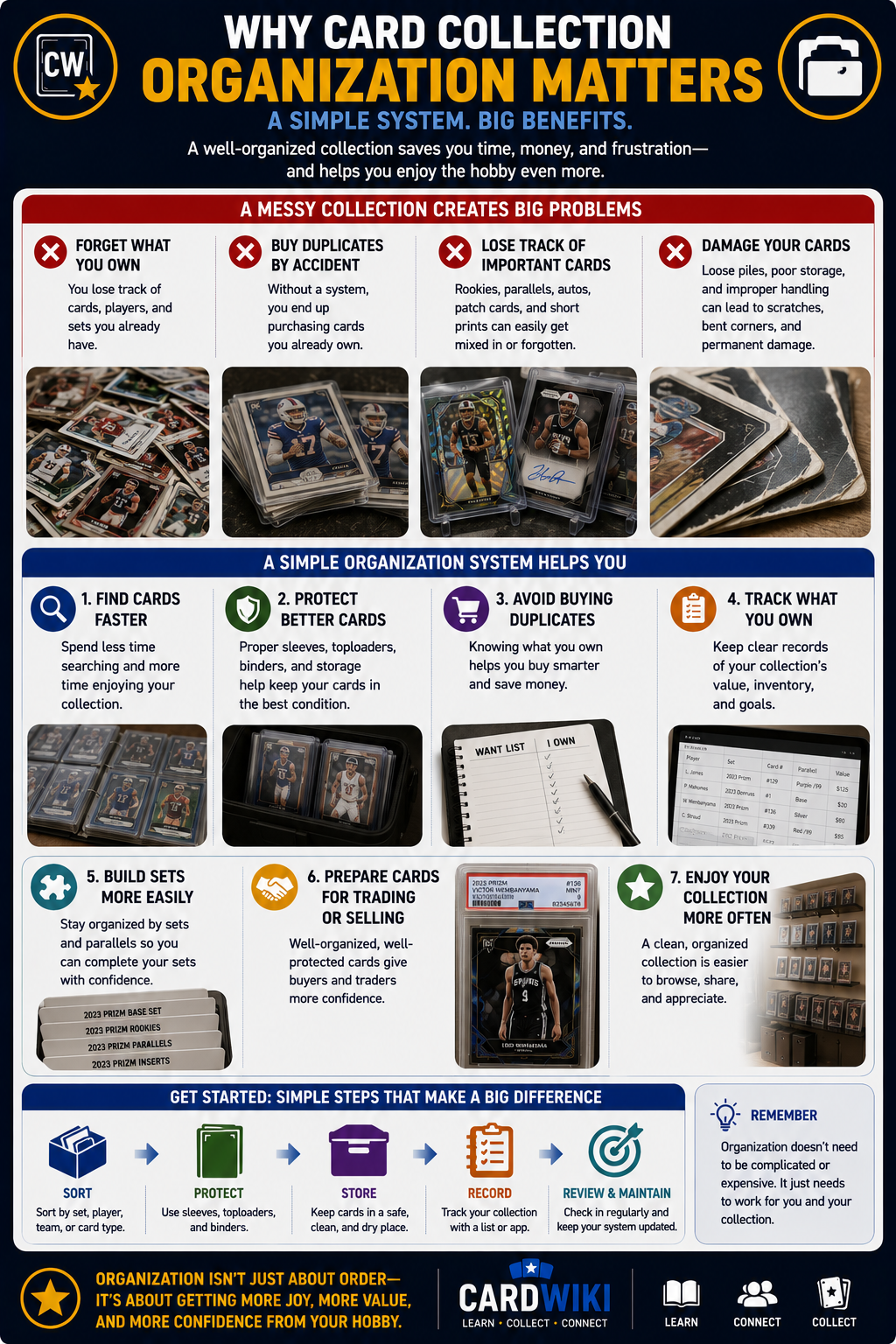
Why Card Collection Organization Matters
A messy collection makes everything harder. You forget what you own. You buy duplicates by accident. You lose track of rookies, parallels, autos, patch cards, and favorite players. You may even damage cards because they are sitting loose in piles instead of being stored properly.
A simple organization system helps you:
- Find Cards Faster
- Protect Better Cards
- Avoid Buying Duplicates
- Track What You Own
- Build Sets More Easily
- Prepare Cards For Trading Or Selling
- Enjoy Your Collection More Often
Organization does not need to be fancy. It just needs to make your cards easier to understand.
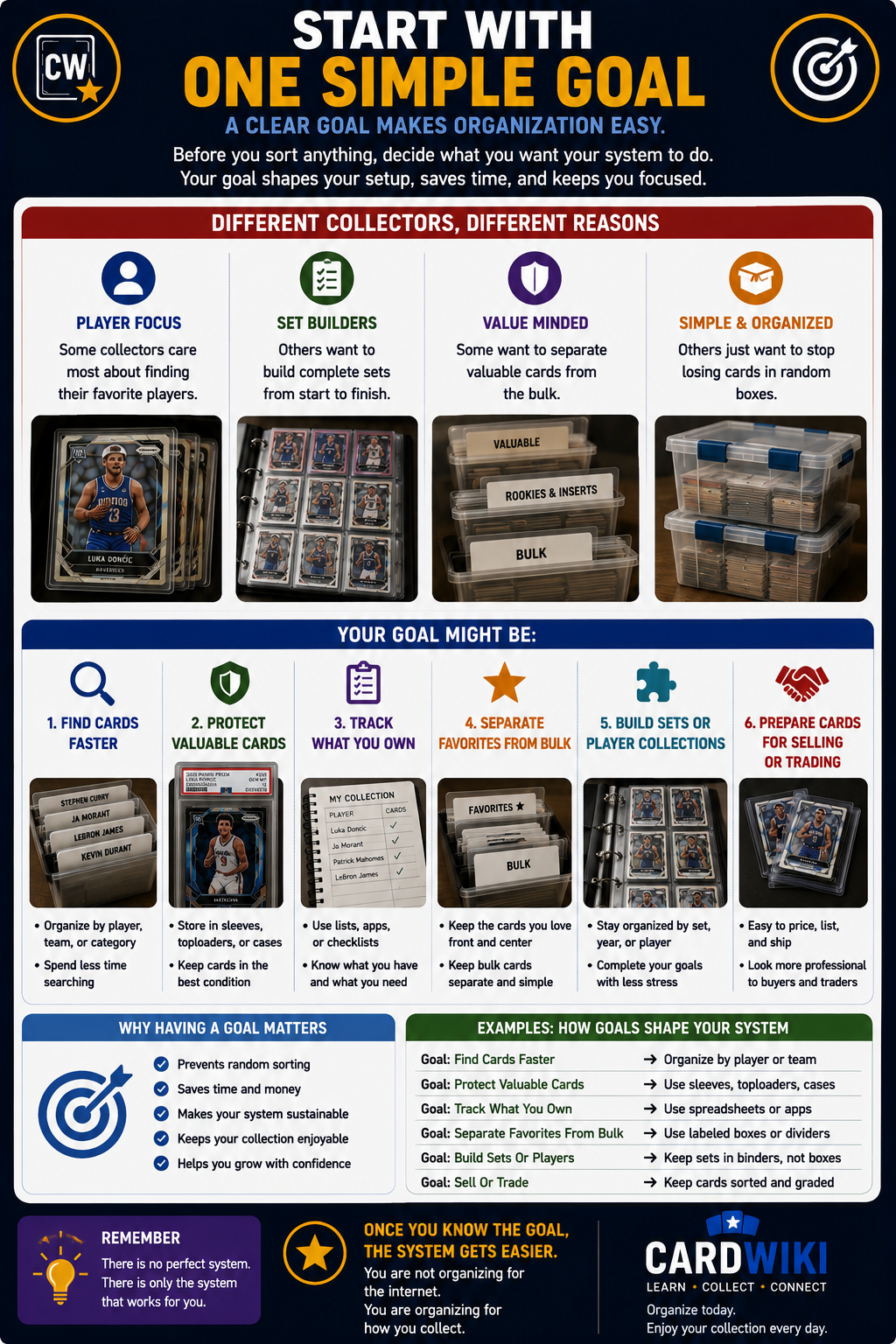
Start With One Simple Goal
Before you sort anything, decide what you want your system to do.
Some collectors care most about finding their favorite players. Others want to build complete sets. Some want to separate valuable cards from the bulk. Others just want to stop losing cards in random boxes.
Your goal might be:
- Find Cards Faster
- Protect Valuable Cards
- Track What You Own
- Separate Favorites From Bulk
- Build Sets Or Player Collections
- Prepare Cards For Selling Or Trading
Once you know the goal, the system gets easier. You are not organizing for the internet. You are organizing for how you collect.
Sort Your Cards Into Broad Groups First
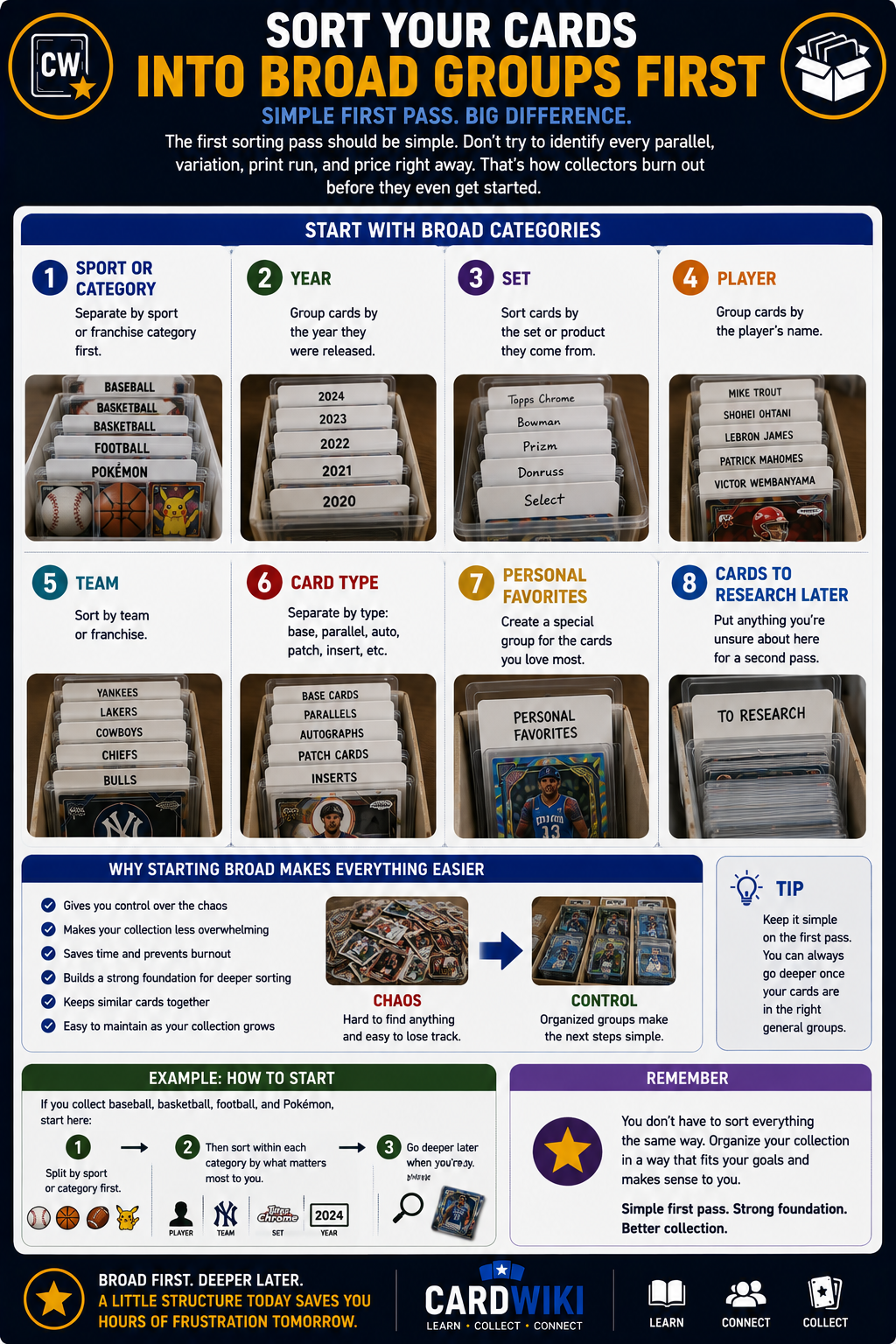
The first sorting pass should be simple. Do not try to identify every parallel, variation, print run, and price point right away. That is how collectors burn out before they even get started.
Start with broad categories:
- Sport Or Category
- Year
- Set.
- Player
- Team.
- Card Type
- Personal Favorites
- Cards To Research Later
This gives you control over the chaos. Once your collection is divided into larger groups, you can go deeper later.
For example, if you collect baseball, basketball, football, and Pokémon, start there. Separate the categories first. After that, you can sort baseball by player, team, set, or year, depending on what matters most to you.
Separate Cards By Purpose
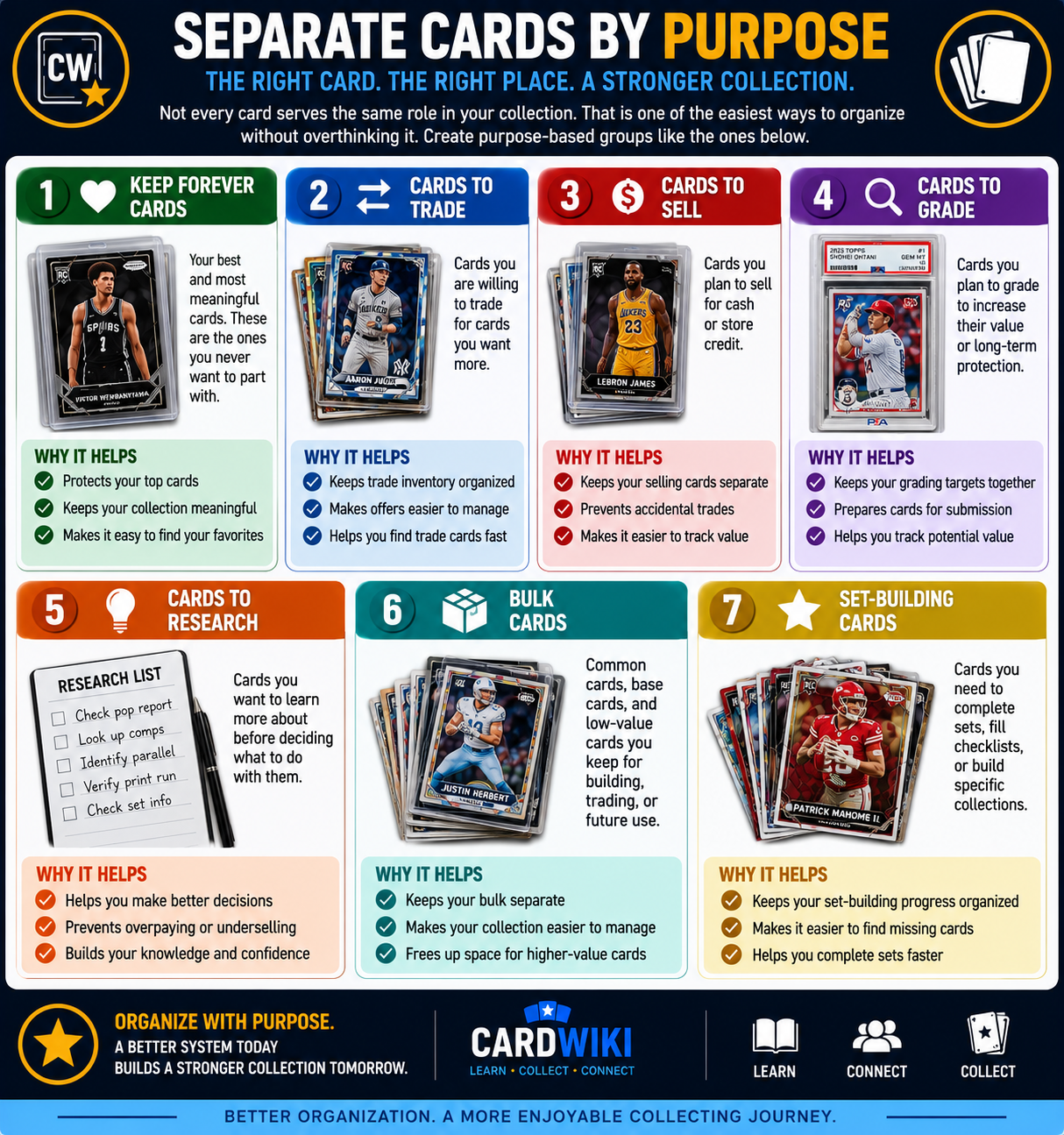
Not every card serves the same role in your collection. That is one of the easiest ways to organize without overthinking it.
Create purpose-based groups like:
- Keep Forever Cards
- Cards To Trade
- Cards To Sell
- Cards To Grade
- Cards To Research
- Bulk Cards
- Set-Building Cards
This helps you avoid treating every card the same. A favorite rookie does not belong in the same workflow as a common base card. A card you plan to sell should be easier to find than a duplicate you keep as trade bait.
Purpose-based sorting also helps when your collection grows. Instead of asking, “Where does this card go?” you can ask, “What do I plan to do with this card?”
Choose Storage That Matches The Card
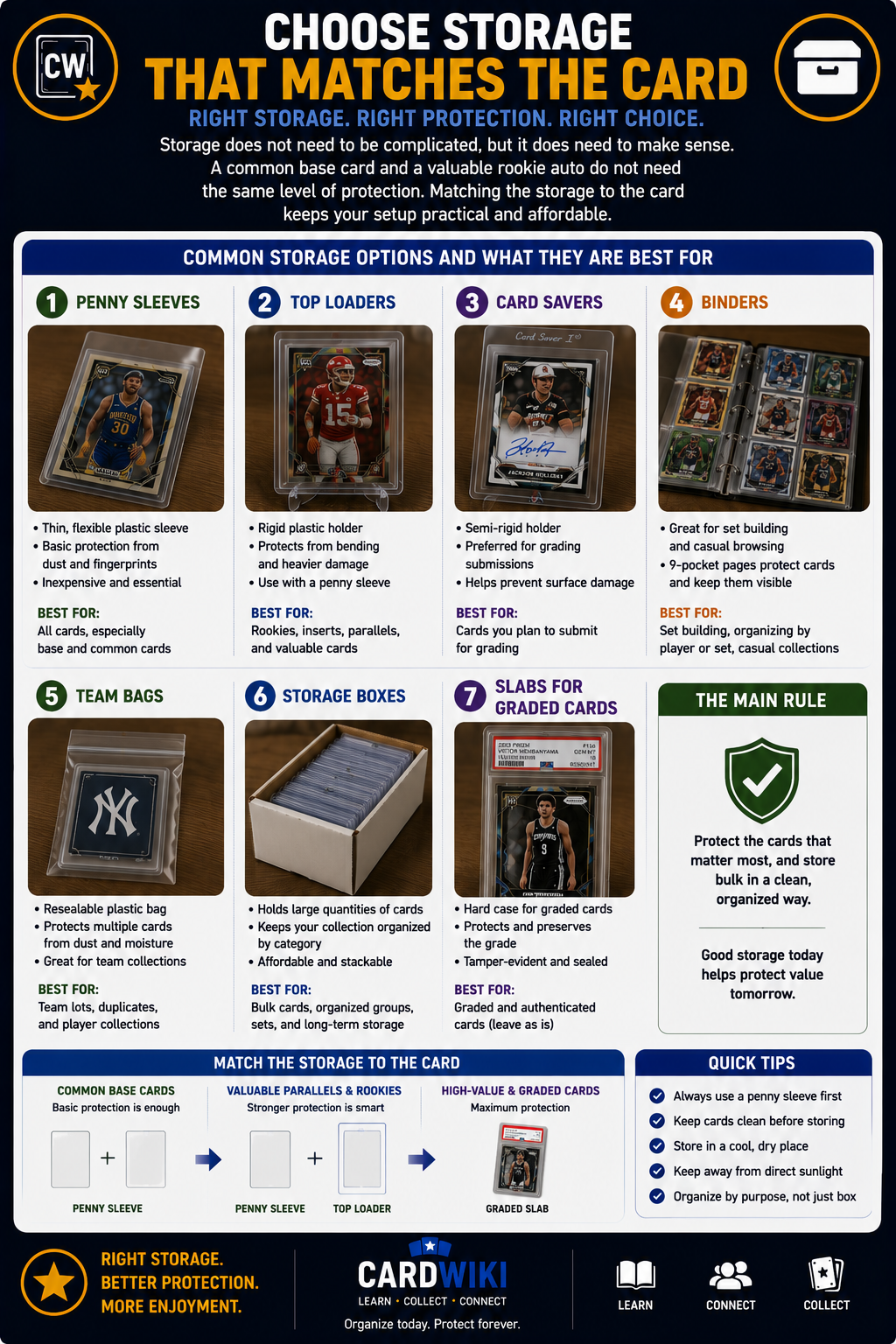
Storage does not need to be complicated, but it does need to make sense.
A common base card and a valuable rookie auto do not need the same level of protection. Matching the storage to the card keeps your setup practical and affordable.
Common storage options include:
- Penny Sleeves
- Top Loaders
- Card Savers
- Binders
- Team Bags
- Storage Boxes
- Slabs For Graded Cards
Penny sleeves are great for basic protection. Top loaders are useful for cards you want to protect more seriously. Card savers are often used for grading submissions. Binders can be great for set building or casual browsing. Storage boxes work well for bulk and organized groups. Slabs are for graded cards that have already been authenticated and sealed.
The main rule is simple: protect the cards that matter most, and store bulk in a clean, organized way.
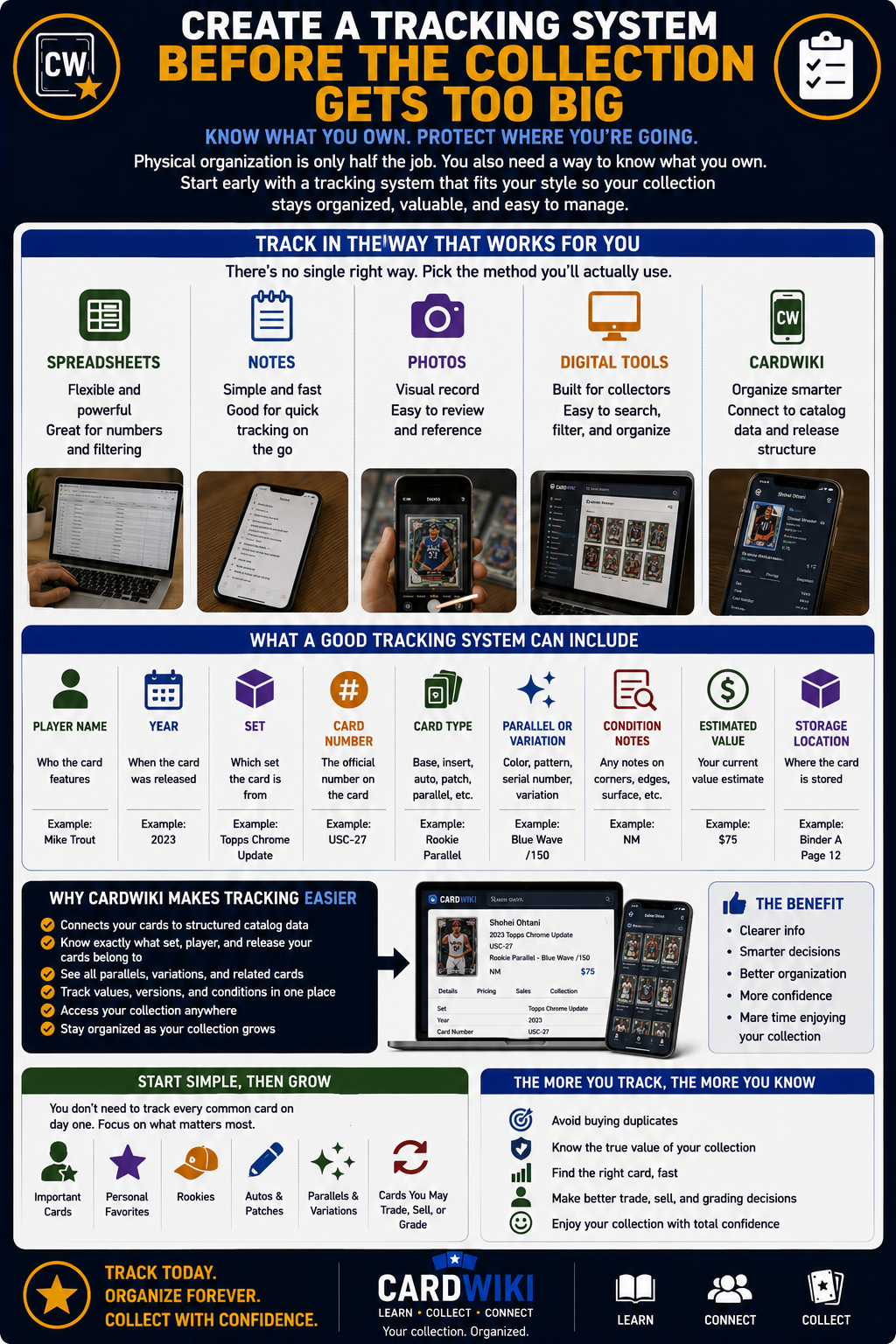
Create A Tracking System Before The Collection Gets Too Big
Physical organization is only half the job. You also need a way to know what you own.
That can be as simple or detailed as you want. Some collectors use spreadsheets. Some use notes. Some take photos. Some use digital collection tools.
A good tracking system can include:
- Player Name
- Year
- Set
- Card Number
- Card Type
- Parallel Or Variation
- Condition Notes
- Estimated Value
- Storage Location
This is where CardWiki fits naturally. If you want a cleaner way to track your cards, CardWiki helps you organize your collection and connect cards to structured catalog data. That makes it easier to understand what you own, where each card fits, and how cards relate to sets, players, and releases.
You do not need to track every common card on day one. Start with important cards, favorites, rookies, autos, patches, parallels, and anything you may want to trade, sell, or grade.
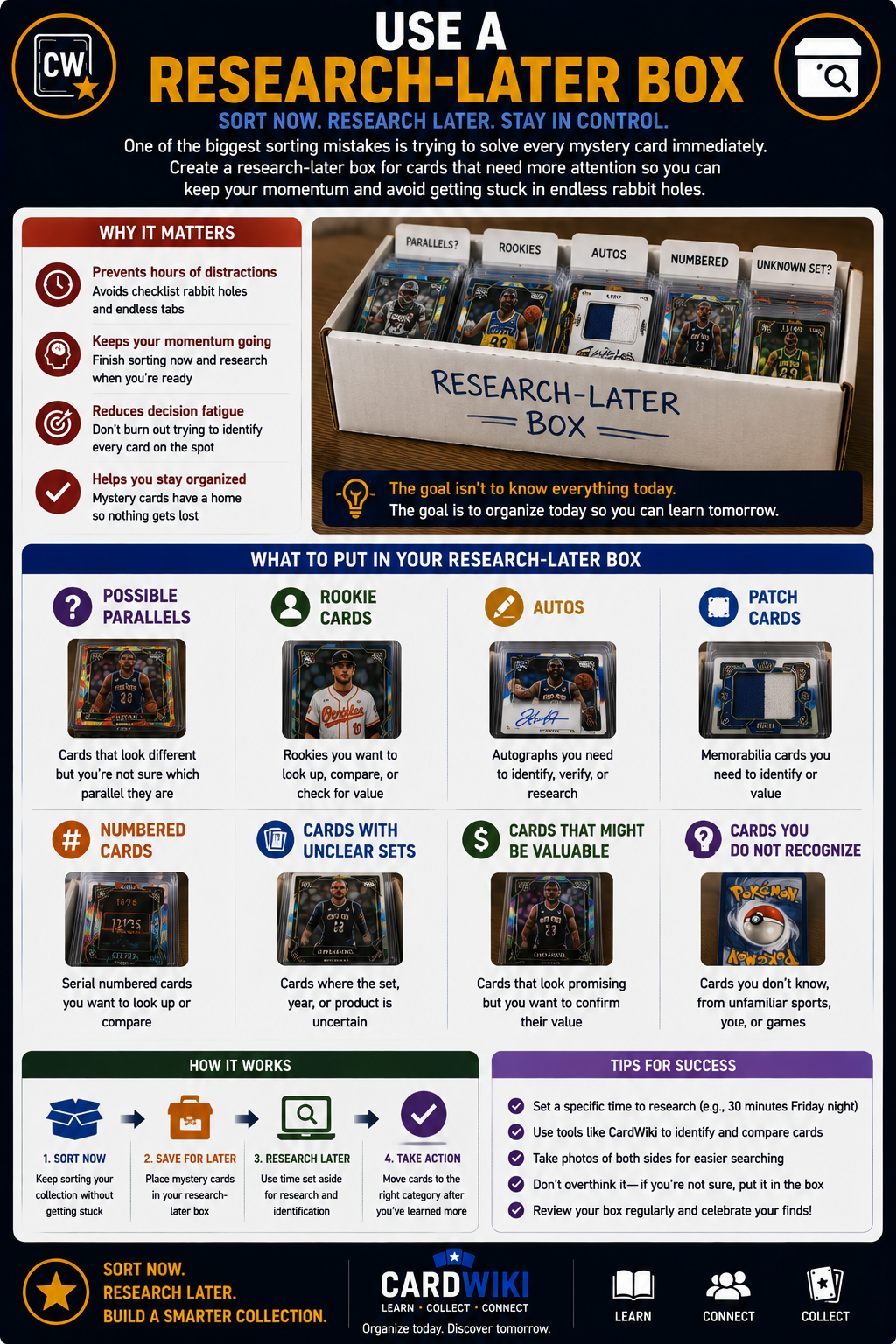
Use A Research-Later Box
One of the biggest sorting mistakes is trying to solve every mystery card immediately.
You find a shiny card and wonder if it is a parallel. You find an older rookie and wonder if it is worth grading. You find a card with a different finish and get pulled into a checklist rabbit hole.
That is how a one-hour sorting session turns into six hours of tabs and confusion.
Create a research-later box or pile for cards that need more attention. Use it for:
- Possible Parallels
- Rookie Cards
- Autos
- Patch Cards
- Numbered Cards
- Cards With Unclear Sets
- Cards That Might Be Valuable
- Cards You Do Not Recognize
This keeps your momentum going. You can sort now and research later.
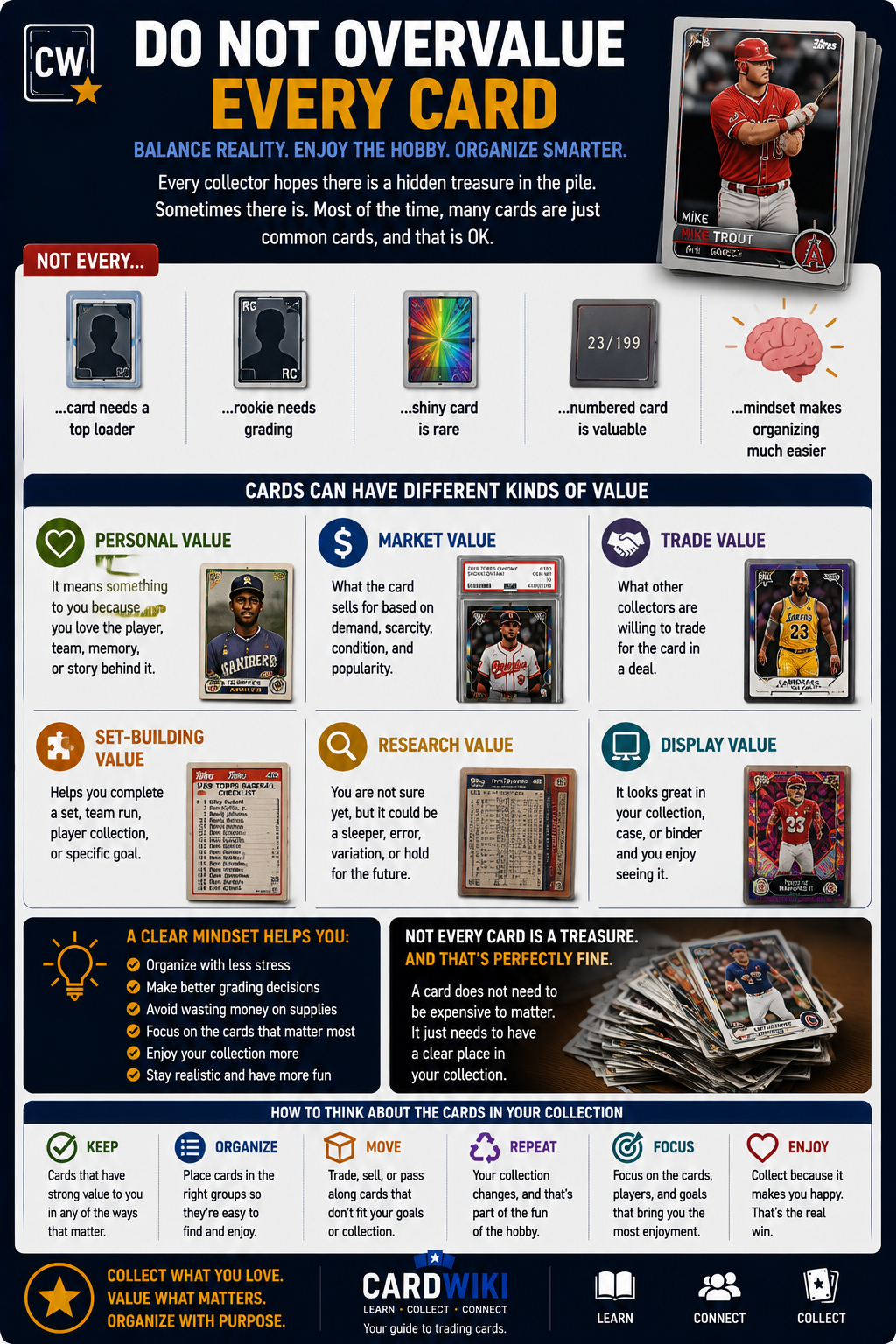
Do Not Overvalue Every Card
Every collector hopes there is a hidden treasure in the pile. Sometimes there is. Most of the time, many cards are just common cards, and that is fine.
Not every card needs a top loader. Not every rookie needs grading. Not every shiny card is rare. Not every numbered card is valuable.
That mindset makes organizing much easier.
Cards can have different kinds of value:
- Personal Value
- Market Value
- Trade Value
- Set-Building Value
- Research Value
- Display Value
A card does not need to be expensive to matter. It just needs to have a clear place in your collection.
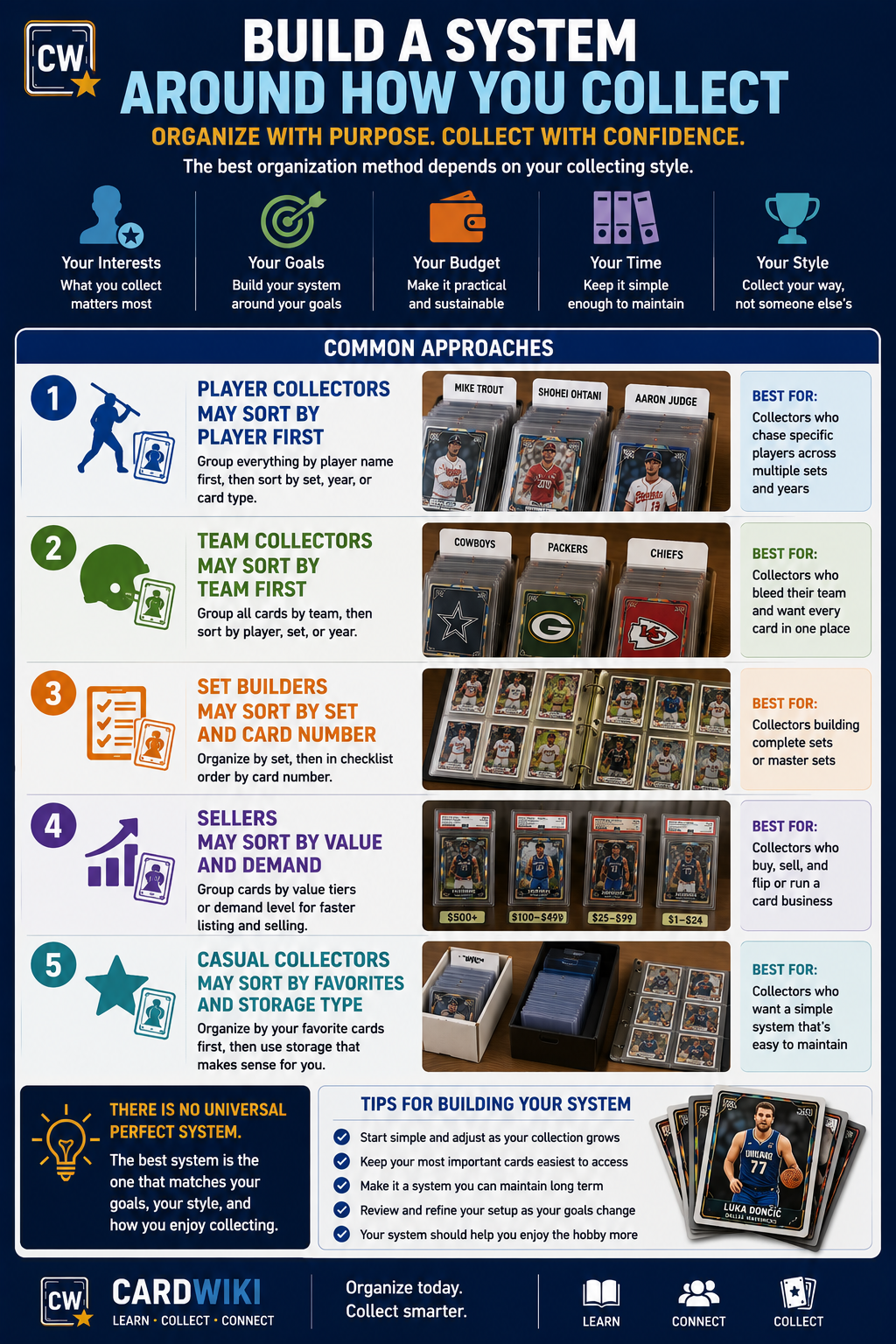
Build A System Around How You Collect
The best organization method depends on your collecting style.
A player collector may want everything sorted by player name. A team collector may want everything grouped by team. A set builder may care most about year, release, and checklist number. A seller may organize by value and demand.
Common approaches include:
- Player Collectors May Sort By Player First
- Team Collectors May Sort By Team First
- Set Builders May Sort By Set And Card Number
- Sellers May Sort By Value And Demand
- Casual Collectors May Sort By Favorites And Storage Type
There is no universal perfect system. The best system is the one that matches your goals.
How To Organize Cards By Set
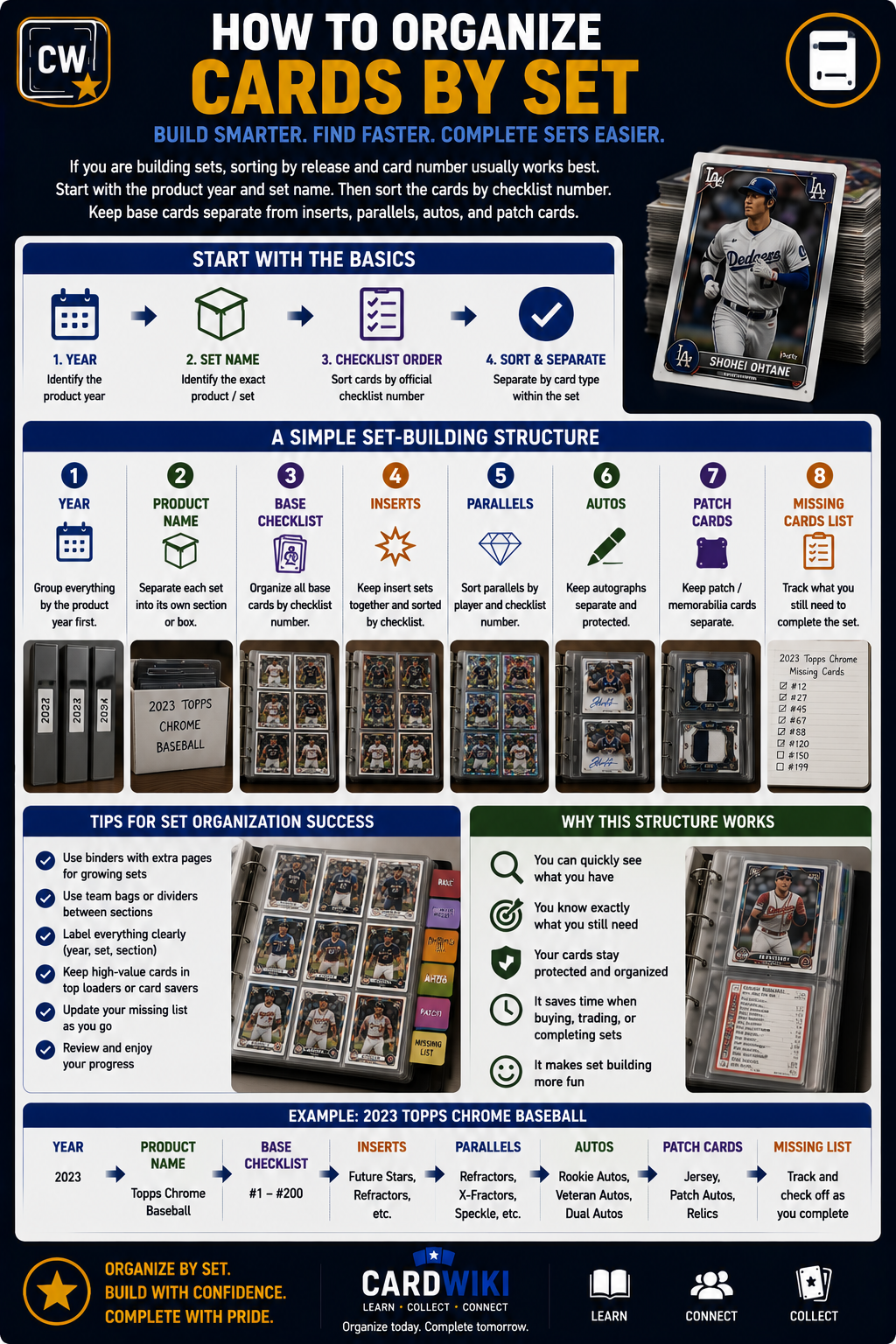
If you are building sets, sorting by release and card number usually works best.
Start with the product year and set name. Then sort the cards by checklist number. Keep base cards separate from inserts, parallels, autos, and patch cards.
A simple set-building structure might look like this:
- Year
- Product Name
- Base Checklist
- Inserts
- Parallels
- Autos
- Patch Cards
- Missing Cards List
This makes it much easier to see what you have and what you still need.
How To Organize Cards By Player Or Team
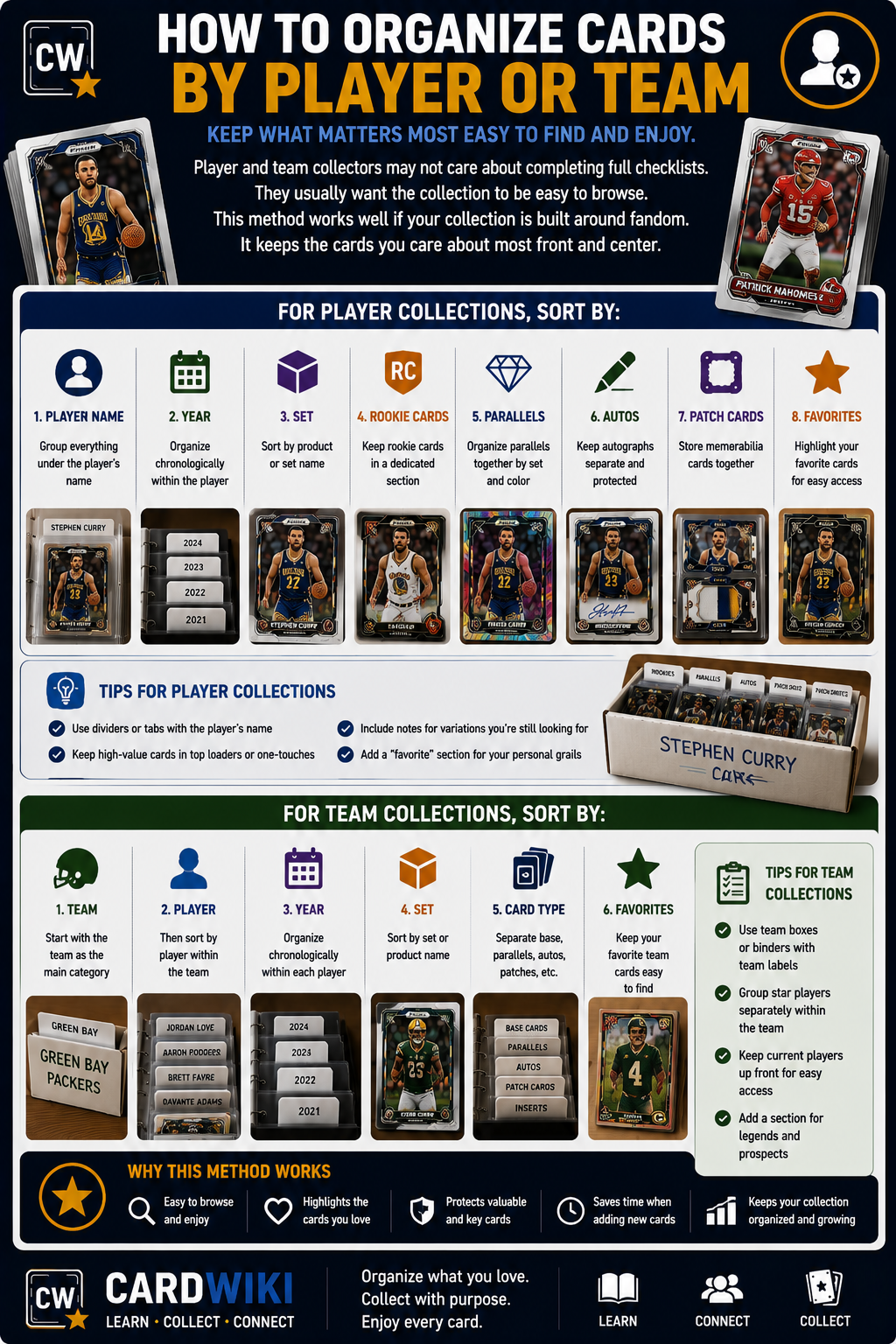
Player and team collectors may not care about completing full checklists. They usually want the collection to be easy to browse.
For player collections, sort by:
- Player Name
- Year
- Set
- Rookie Cards
- Parallels
- Autos
- Patch Cards
- Favorites
For team collections, sort by:
- Team
- Player
- Year
- Set
- Card Type
- Favorites
This method works well if your collection is built around fandom. It keeps the cards you care about most front and center.
How To Organize Valuable Cards
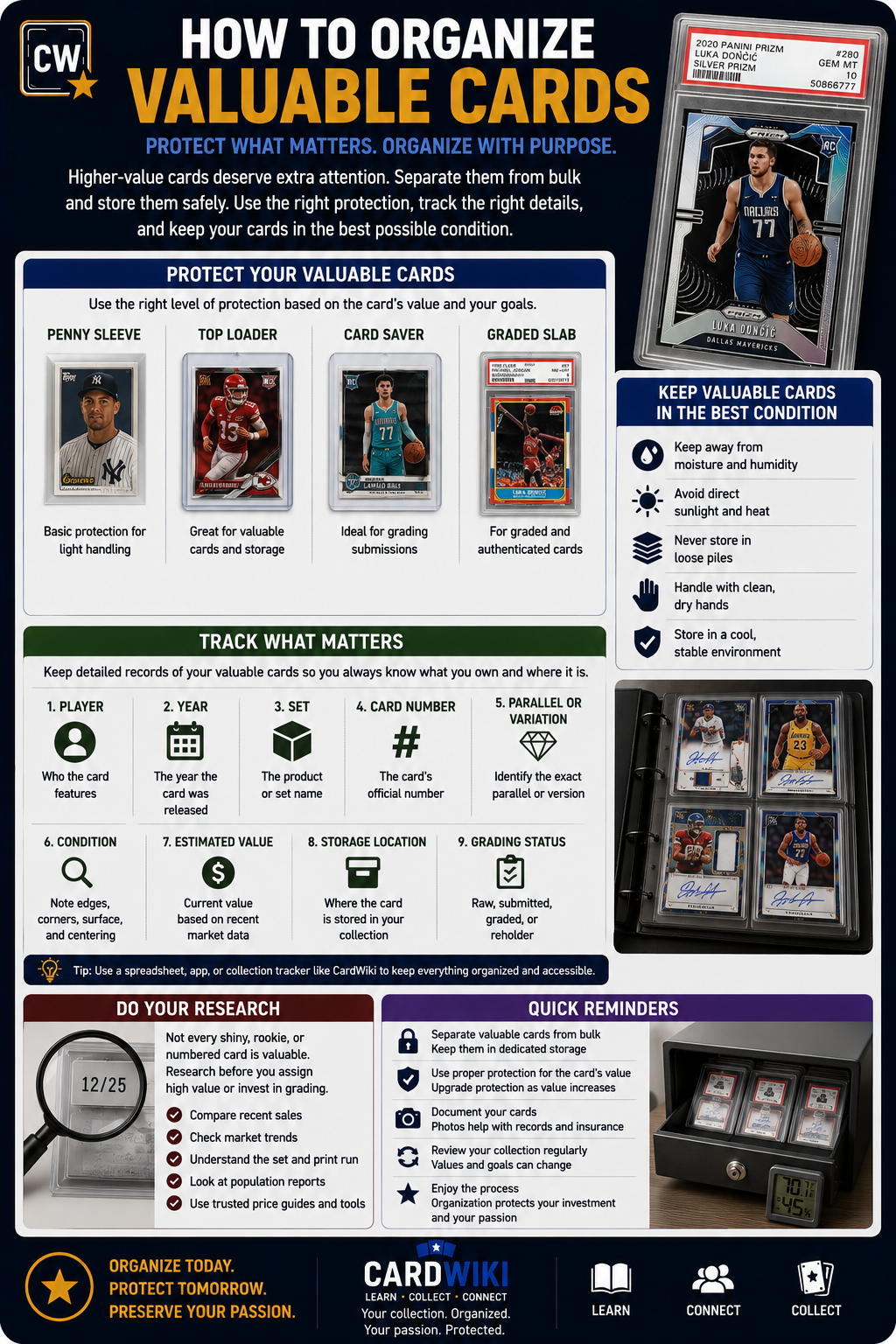
Higher-value cards deserve extra attention.
Separate them from bulk and store them safely. Use sleeves, top loaders, card savers, or gradedin slabs depending on the card. Keep them away from moisture, direct sunlight, and loose piles where corners can get damaged.
For valuable cards, track:
- Player
- Year
- Set
- Card Number
- Parallel Or Variation
- Condition
- Estimated Value
- Storage Location
- Grading Status
Do not assume every shiny, rookie, or numbered card is valuable. Research matters. The organization should make that research easier, not more stressful.
Common Beginner Mistakes To Avoid
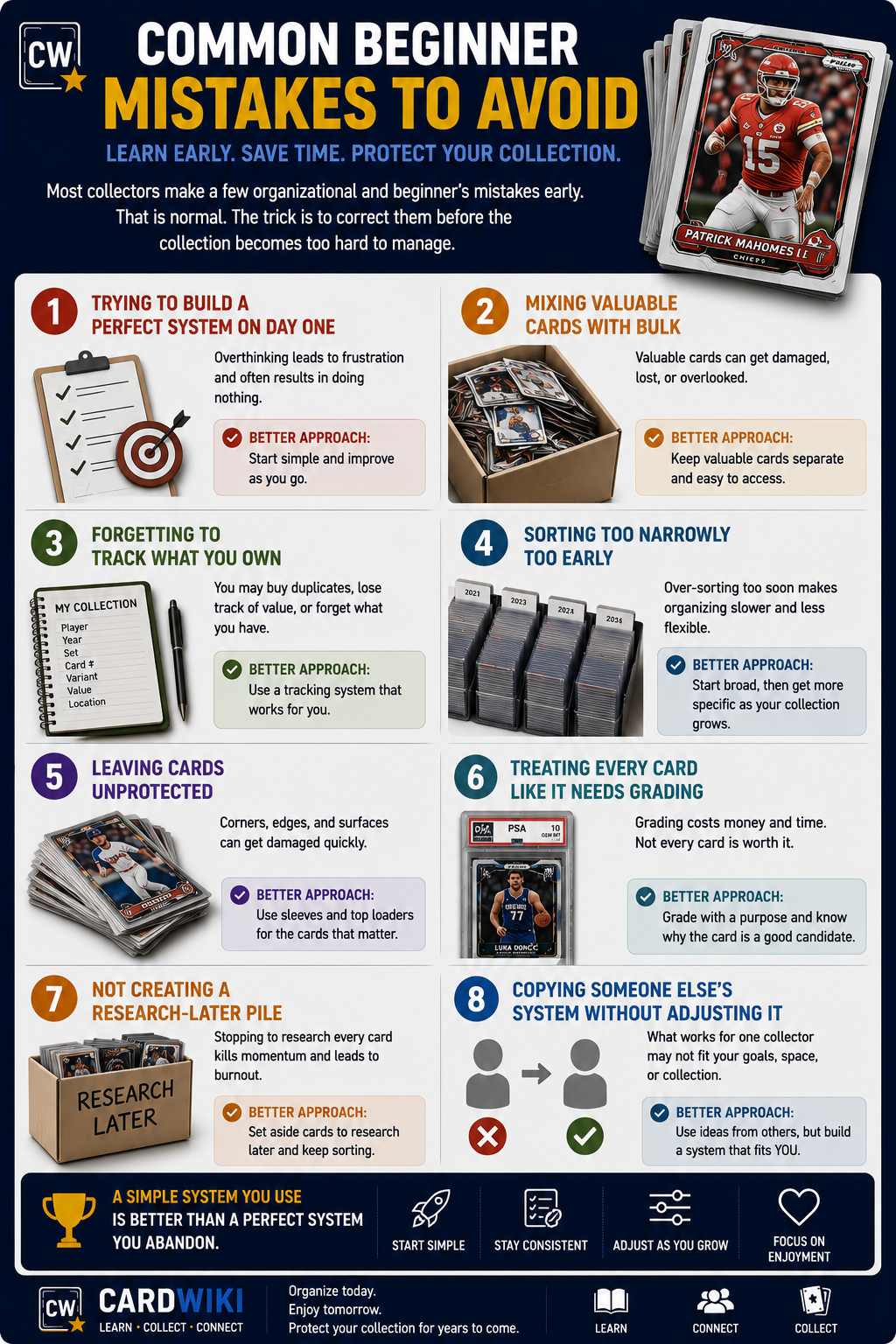
Most collectors make a few organizational and beginner's mistakes early. That is normal. The trick is to correct them before the collection becomes too hard to manage.
Common mistakes include:
- Trying To Build A Perfect System On Day One
- Mixing Valuable Cards With Bulk
- Forgetting To Track What You Own
- Sorting Too Narrowly Too Early
- Leaving Cards Unprotected
- Treating Every Card Like It Needs Grading
- Not Creating A Research-Later Pile
- Copying Someone Else’s System Without Adjusting It
A simple system you use is better than a perfect system you abandon.
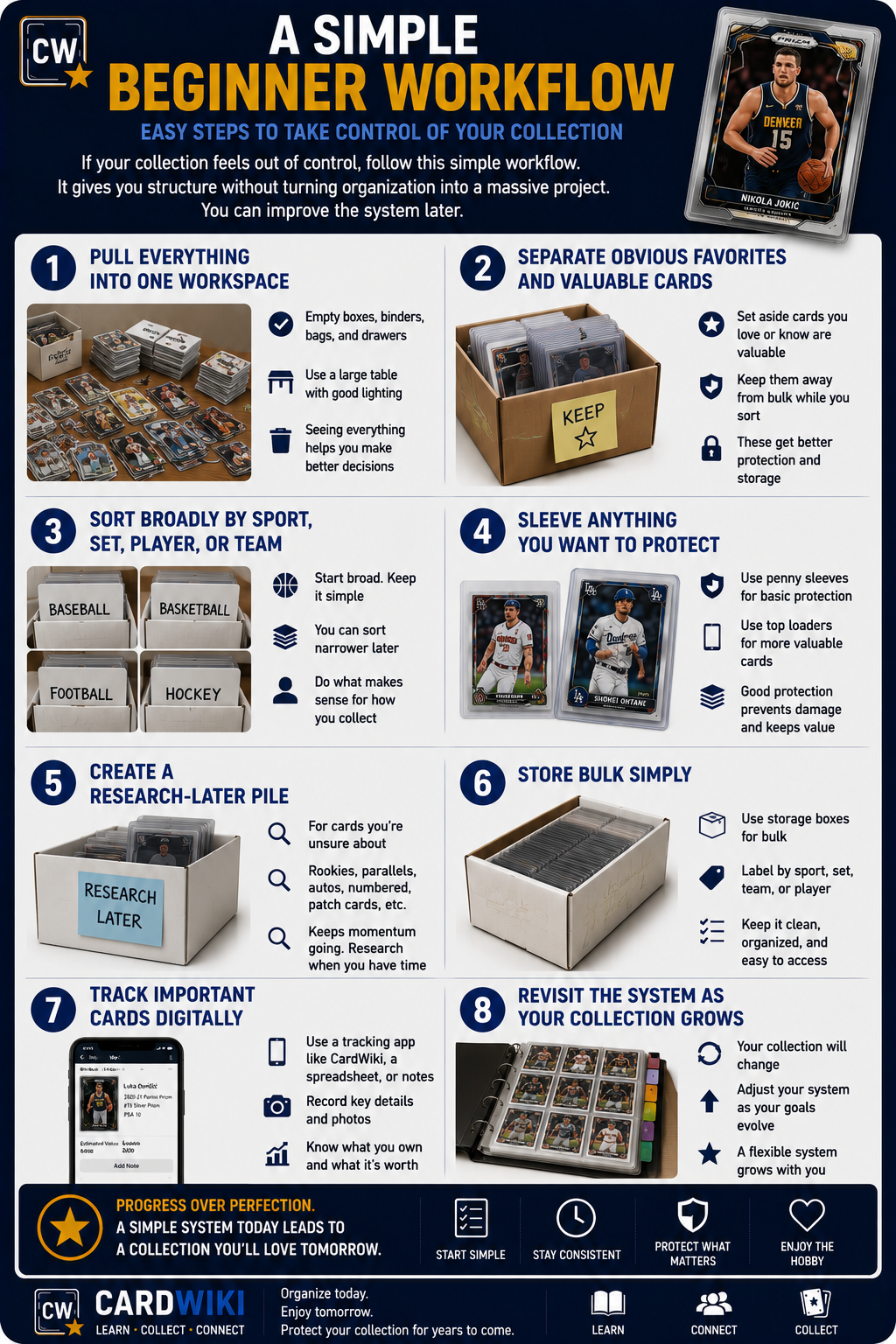
A Simple Beginner Workflow
Here is an easy workflow if your collection feels out of control.
- Pull Everything Into One Workspace
- Separate Obvious Favorites And Valuable Cards
- Sort Broadly By Sport, Set, Player, Or Team
- Sleeve Anything You Want To Protect
- Create A Research-Later Pile
- Store Bulk Simply
- Track Important Cards Digitally
- Revisit The System As Your Collection Grows
This gives you a starting point without turning the organization into a massive project. You can improve the system later.
Final Thoughts
Learning how to organize your card collection does not mean building a complicated system with endless categories. It means creating enough structure to make the hobby easier and more enjoyable.
Start broad. Protect the cards that matter. Track what you own. Create a research-later pile. Build around the way you actually collect.
Your system can grow with you. It does not need to be perfect today.
If you’re ready to bring order to your collection, CardWiki can help you track your cards, understand what you own, and build a cleaner collection from day one.
FAQs ABout Organizing Card Collections
What Is The Best Way To Organize A Card Collection?
The best way to organize a card collection is to start with broad groups, such as sport, set, player, team, or card type. From there, you can add more detail as your collection grows.
Should I Organize Cards By Player, Team, Set, Or Value?
It depends on how you collect. Player collectors may sort by player, team collectors by team, set builders by checklist number, and sellers by value.
How Do I Store Trading Cards Safely?
Store cards in penny sleeves, top loaders, binders, boxes, or slabs, depending on the card’s importance. Keep cards away from moisture, heat, direct sunlight, and loose piles.
Should Every Card Go In A Top Loader?
No. Top loaders are best for cards you want to protect more seriously. Common bulk cards can usually be stored in sleeves, boxes, or binders.
How Do I Track My Card Collection?
You can track your collection with a spreadsheet, notes, photos, or a digital tool like CardWiki. Tracking helps you know what you own and avoid buying duplicates.
What Should I Do With Common Cards?
Common cards can be sorted by sport, team, set, or player, and stored in boxes. You can also use them for set building, trading, donating, or bulk storage.
How Do I Organize Valuable Cards?
Separate valuable cards from bulk, protect them in sleeves, top loaders, or slabs, and track key details such as set, card number, condition, and storage location.
How Often Should I Reorganize My Collection?
Reorganize whenever your system stops working. For some collectors, that may be every few months. For others, a quick update after each major purchase or rip is enough.
Can Beginners Organize Cards Without Spending Much Money?
Yes. Beginners can start with penny sleeves, basic storage boxes, and a simple tracking system. You can always upgrade storage later as your collection grows.