How To Read A Graded Card Label: Understanding Every Part Of A PSA, BGS, Or SGC Slab
Learn how to read a graded card label, what every section means, and how PSA, BGS, and SGC slabs identify and authenticate trading cards.
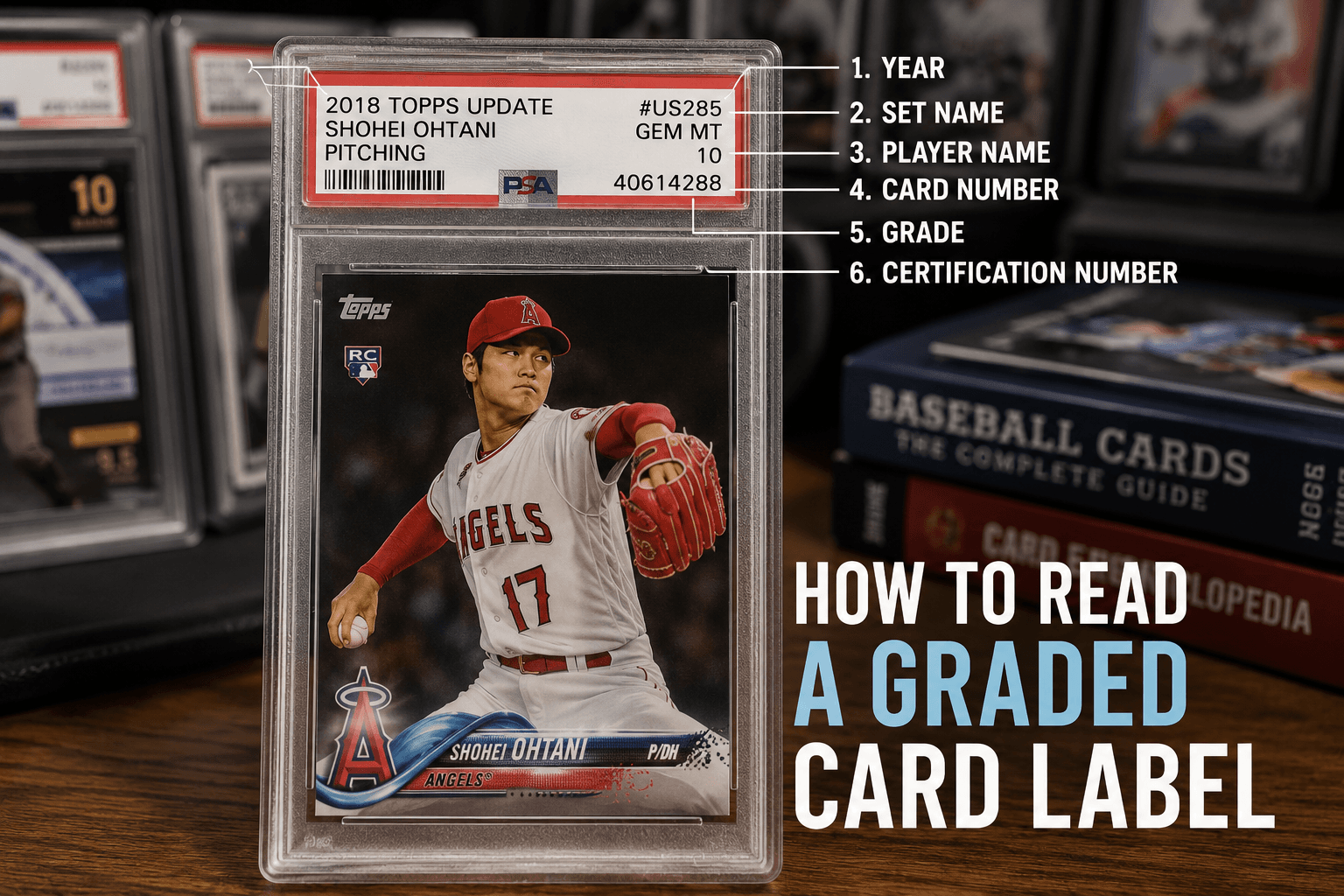
If you've ever looked at a graded trading card, you've probably noticed there is much more on the label than just a grade.
There may be a certification number, the player's name, the card year, manufacturer, set, card number, parallel, autograph designation, and sometimes additional notes depending on the grading company.
At first glance, it can seem like a lot of information packed into a small label.
Once you understand what each section represents, though, a graded card label becomes one of the fastest ways to identify exactly what card you're looking at.
It is also one of the reasons grading has become so important in modern collecting.
A slab does more than protect a card. It provides a standardized identity that helps collectors buy, sell, verify, and organize cards with confidence.
Understanding that identity is exactly where CardWiki's structured catalog approach fits naturally.
Why Graded Card Labels Matter
A graded card label serves several purposes at once.
It identifies the card.
It records the assigned grade.
It links the card to a certification record.
It helps collectors distinguish one version of a card from another.
A label typically communicates:
- Card Identity
- Grading Company
- Numeric Grade
- Certification Number
- Card Description
- Authentication Status
- Special Designations
Without the label, many cards would require much more research to identify accurately.
What Information Appears On A Graded Card Label?
While every grading company uses its own layout, most labels include similar information.
Common fields include:
- Grading Company
- Year
- Manufacturer
- Set Name
- Player Or Subject
- Card Number
- Parallel Or Variation
- Autograph Designation
- Grade
- Certification Number
Some labels include even more information depending on the product.
The Grading Company
The grading company is usually the first thing collectors notice.
Examples include:
- PSA
- Beckett (BGS)
- SGC
- CGC
- TAG
Each company uses its own label design, certification system, and holder.
The grading company does not change the identity of the card.
It simply identifies who evaluated and authenticated it.
The Card Grade
The numeric grade reflects the grading company's assessment of the card's condition.
Grades typically consider:
- Corners
- Edges
- Surface
- Centering
- Print Quality
Higher grades generally indicate stronger overall condition.
The grade is one piece of the card's identity, but it should never replace the identity itself.
The Certification Number
Every professionally graded card receives a unique certification number.
This number allows collectors to:
- Verify Authenticity
- View Certification Records
- Confirm Population Reports
- Match The Card To Official Databases
- Research The Slab
Certification numbers help build trust between buyers and sellers.
They also provide an important evidence trail.
The Year
The year identifies the product year associated with the card.
This helps distinguish similar cards that may exist across multiple seasons.
For example, the same player may appear in products from:
- 2022
- 2023
- 2024
- 2025
The year is one of the most important identity fields.
The Manufacturer
The manufacturer identifies the company that produced the product.
Examples include:
- Topps
- Panini
- Upper Deck
- Leaf
This information helps separate products that may share similar player photography but come from completely different releases.
The Set Name
The set tells collectors which product the card belongs to.
Examples include:
- Topps Chrome
- Bowman Draft
- Prizm
- Donruss Optic
- Finest
The set is one of the strongest pieces of card identity.
Without it, identifying the exact card becomes much harder.
The Player Or Subject
Every label identifies the player, athlete, character, or subject featured on the card.
Combined with the year and set, this narrows the identity significantly.
However, it is still not enough by itself.
The Card Number
Most cards include a card number assigned within the checklist.
Examples include:
- #1
- #87
- #250
- #US45
- #BCP-17
Card numbers help distinguish players who appear multiple times within the same release.
They also connect directly to official checklists.
Parallel Designations
If the graded card is a parallel, the label often identifies it.
Examples include:
- Gold
- Blue Refractor
- Red Wave
- Silver Prizm
- Black Ice
Without this information, collectors could easily confuse two cards that look nearly identical.
Variation Information
Some grading labels identify recognized variations.
Examples may include:
- Photo Variation
- Image Variation
- Short Print
- Super Short Print
- Alternate Image
Variation information helps distinguish different versions of the same base card.
Serial Number Information
If the card is serial numbered, the slab may include that information.
Examples include:
- /25
- /50
- /99
- /299
Serial numbering is another identity factor that helps distinguish specific versions.
Autograph Designations
Autographed cards often receive additional label information.
This may identify:
- Certified Autograph
- Authentic Autograph
- Pack-Issued Autograph
- Dual Autograph
- Triple Autograph
Some companies also indicate whether the autograph itself has been graded.
Memorabilia Designations
Relic and memorabilia cards may include additional notes.
Examples include:
- Jersey
- Patch
- Patch Auto
- Relic
- Logo Patch
These details help distinguish memorabilia cards from standard base cards.
Why Similar Labels Can Still Represent Different Cards
Two slabs may appear almost identical while representing completely different cards.
Small differences may include:
- Different Parallel
- Different Variation
- Different Card Number
- Different Set
- Different Product Year
- Different Autograph Type
- Different Serial Number
This is why reading the full label matters.
How PSA Labels Differ From BGS And SGC
Every grading company formats labels differently.
PSA emphasizes a clean certification layout.
BGS often includes subgrades on eligible cards.
SGC uses a distinctive black insert holder with its own label design.
Although layouts differ, the core identity fields remain similar.
Collectors should focus on the information, not just the appearance.
Common Beginner Mistakes
Collectors new to grading often assume:
- The Grade Is The Card
- Every PSA 10 Is The Same Card
- Certification Numbers Replace Card Identity
- Parallel Information Is Optional
- Card Number Is Unimportant
- The Label Contains Every Possible Detail
Those assumptions can create confusion when researching cards.
Why Card Labels Support Better Cataloging
A graded label already contains much of the information needed to identify a card.
However, it is still only part of the picture.
A complete catalog should also understand:
- Manufacturer
- Brand
- Product Family
- Product Year
- Release
- Configuration
- Licensing
- Checklist
- Card Number
- Parallel
- Variation
- Serial Number
- Autograph
- Memorabilia
- Certification
- Evidence
Structured data makes searching, comparing, and organizing cards much easier.
Card Labels And Evidence
Certification numbers create an important evidence layer.
They allow collectors to verify:
- Authentication
- Grading Company Records
- Population Reports
- Sales History
- Slab Identity
CardWiki's future evidence model can use certification as one supporting identity factor while still recognizing that the slab itself is only one representation of the underlying card.
Why CardWiki Separates Card Identity From Slab Identity
A slab is not the card.
It is a certified representation of the card.
That distinction matters.
The same card may exist:
- Raw
- PSA Graded
- BGS Graded
- SGC Graded
- Regraded Later
The underlying card identity remains the same.
The slab identity changes.
Treating those as separate concepts creates a much cleaner catalog.
How To Read A Graded Card Label Step By Step
Whenever you pick up a graded card, read the label in this order:
- Identify The Grading Company
- Read The Grade
- Confirm The Certification Number
- Check The Year
- Identify The Manufacturer
- Read The Set Name
- Confirm The Player
- Check The Card Number
- Identify Any Parallel
- Look For Variation Information
- Check Serial Number Details
- Read Any Autograph Or Memorabilia Notes
Following the same process every time helps prevent identification mistakes.
Final Thoughts
A graded card label contains much more than a numeric grade.
It identifies the product, the player, the set, the card number, the variation, the parallel, the certification record, and much more.
Understanding how to read every field helps collectors identify cards more accurately, avoid confusion, and organize collections with greater confidence.
CardWiki extends that idea even further by treating every identity factor as structured data rather than combining everything into one long title.
That approach creates a catalog that is easier to search, easier to compare, and far more useful for collectors.
Whether your card is raw or professionally graded, CardWiki helps you understand exactly what you own through structured card identities, releases, checklists, parallels, variations, certifications, and collection tracking.
FAQs
How Do You Read A PSA Label?
Start with the grading company, then read the grade, certification number, year, manufacturer, set, player, card number, and any parallel or variation information.
What Does A PSA Certification Number Mean?
A certification number uniquely identifies a graded card and allows collectors to verify it through the grading company's database.
Does The Grade Identify The Card?
No. The grade describes the card's condition. The card's identity comes from factors such as the year, manufacturer, set, player, and card number.
What Information Is On A Graded Card Label?
Most labels include the grading company, grade, certification number, year, manufacturer, set, player, card number, and special designations.
Why Do Some Labels Include Parallel Names?
Parallel names help distinguish alternate versions of the same card that may share identical player and card numbers.
Is A PSA Slab The Same As Card Identity?
No. A slab represents one certified version of a card. The underlying card identity remains separate from the grading company.
Can Two Cards Have The Same Grade But Different Identities?
Yes. Two PSA 10 cards may belong to different sets, parallels, years, or variations.
Why Does CardWiki Separate Card Identity From Slab Identity?
Separating the two creates a cleaner catalog that accurately tracks both the underlying card and any certified versions tied to it.