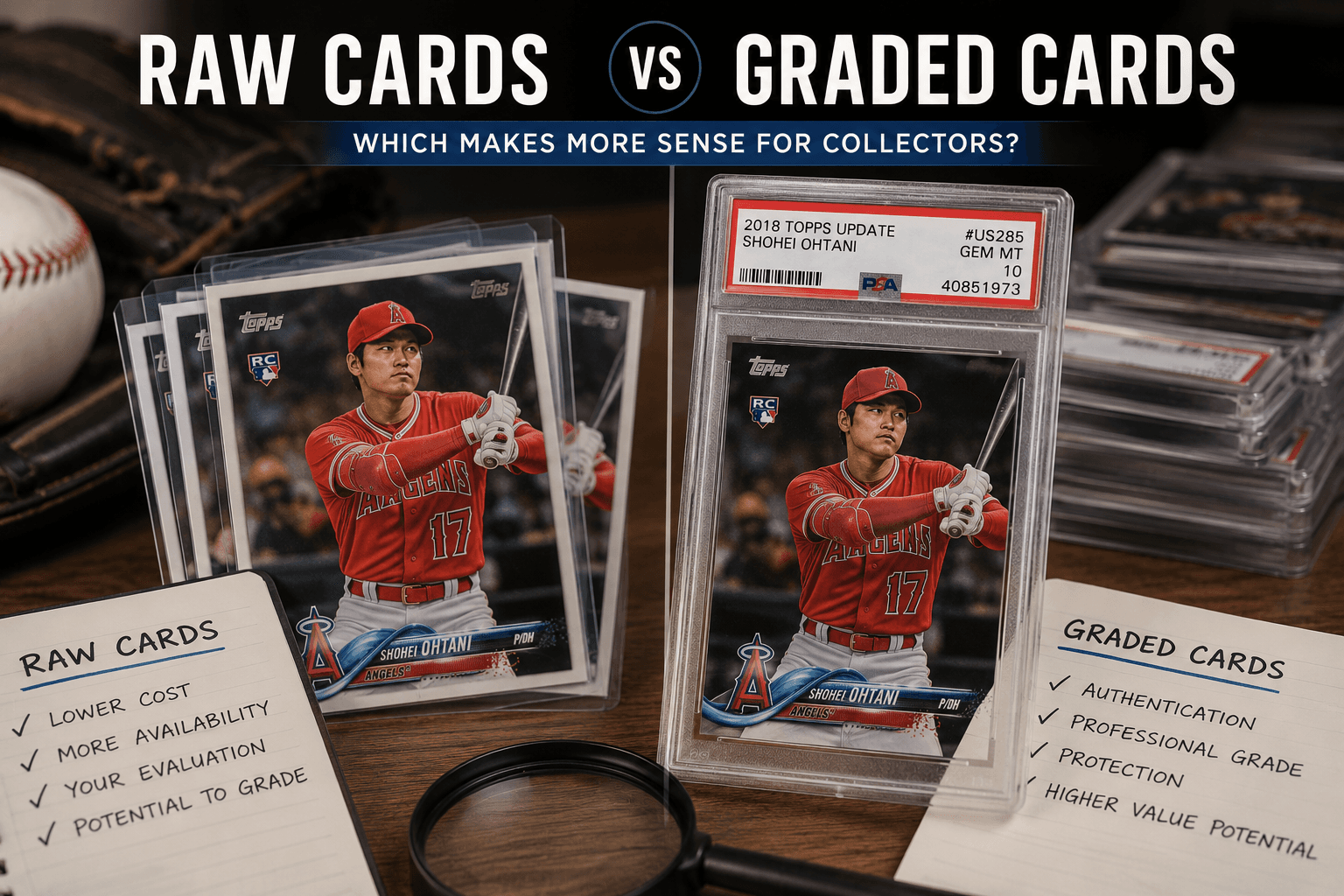
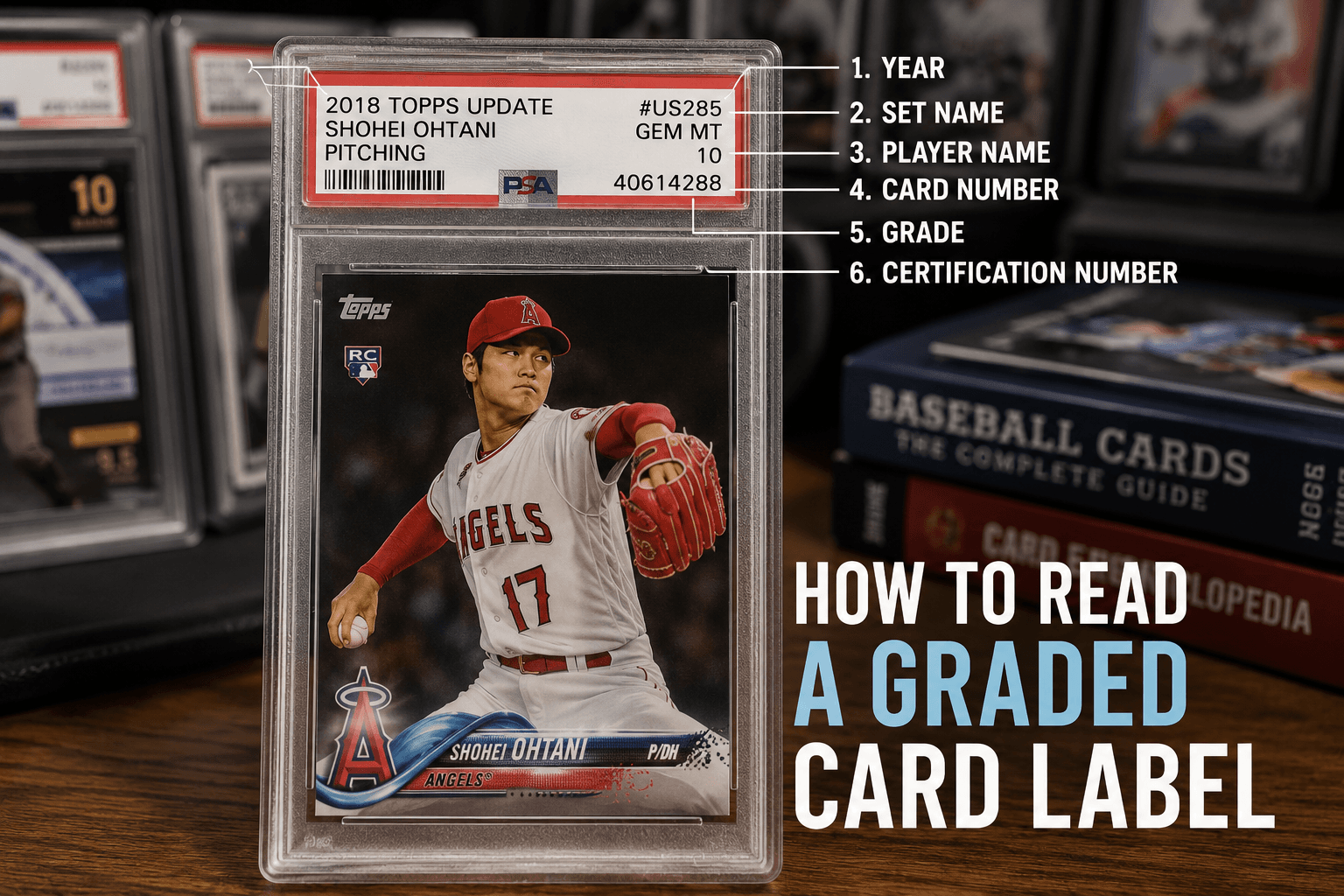
PSA Paused Value Grading Submissions. Here’s What Collectors Should Actually Do About It
Card grading has always been part science, part market psychology, and part cardboard confession booth.
Card grading has always been part science, part market psychology, and part cardboard confession booth.
You look at a card under a light. You tilt it. You convince yourself the corner is probably fine. You check comps. You calculate upside. You imagine the PSA 10 reveal. Then, if you are honest, you ask the question every collector eventually has to ask:
Am I grading this card because it makes sense, or because I really, really want it to make sense?
That question just got more important.
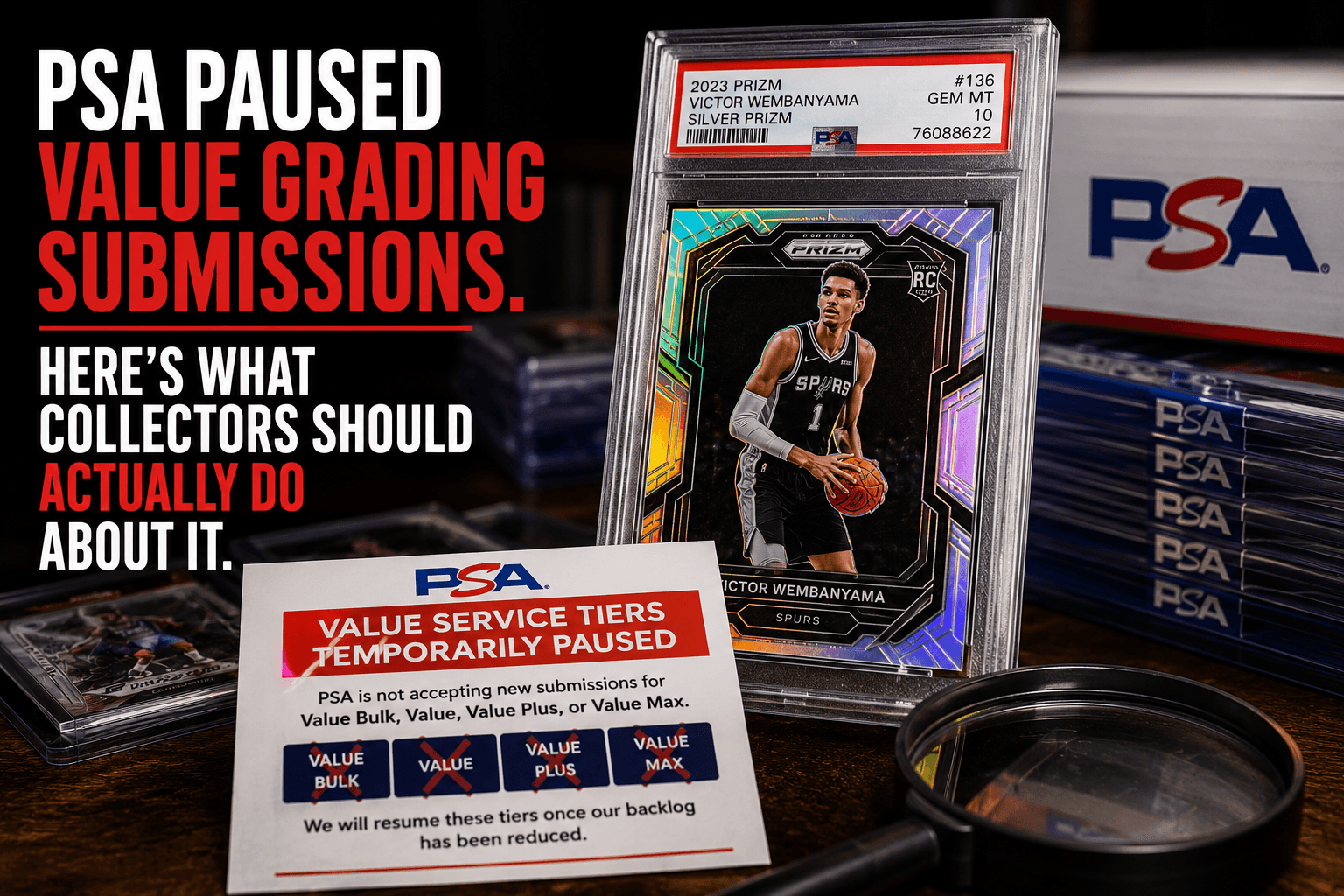
PSA recently announced that, effective June 2, 2026, it is temporarily pausing new submissions for its Value Bulk, Value, Value Plus, and Value Max service tiers. According to PSA, a rapid 20% spike in submissions added about 1.6 million cards to an active backlog that was approaching 10 million cards. PSA says the pause is intended to protect turnaround times for cards already in its care, with the Value tiers expected to reopen once the backlog gets closer to 5 million units. PSA projected that could take up to four months, though the company also made clear the timeline depends on operational progress.
That is the quick answer: PSA is not closed, grading is not dead, but the lower-cost PSA lanes are temporarily unavailable.
The more useful answer is this:
Collectors need to become much more selective.
This is not a panic moment. It is a discipline moment. The hobby does not need fewer collectors grading cards. It needs fewer collectors guessing.
The Quick Version
If you only have a minute, here is what matters.
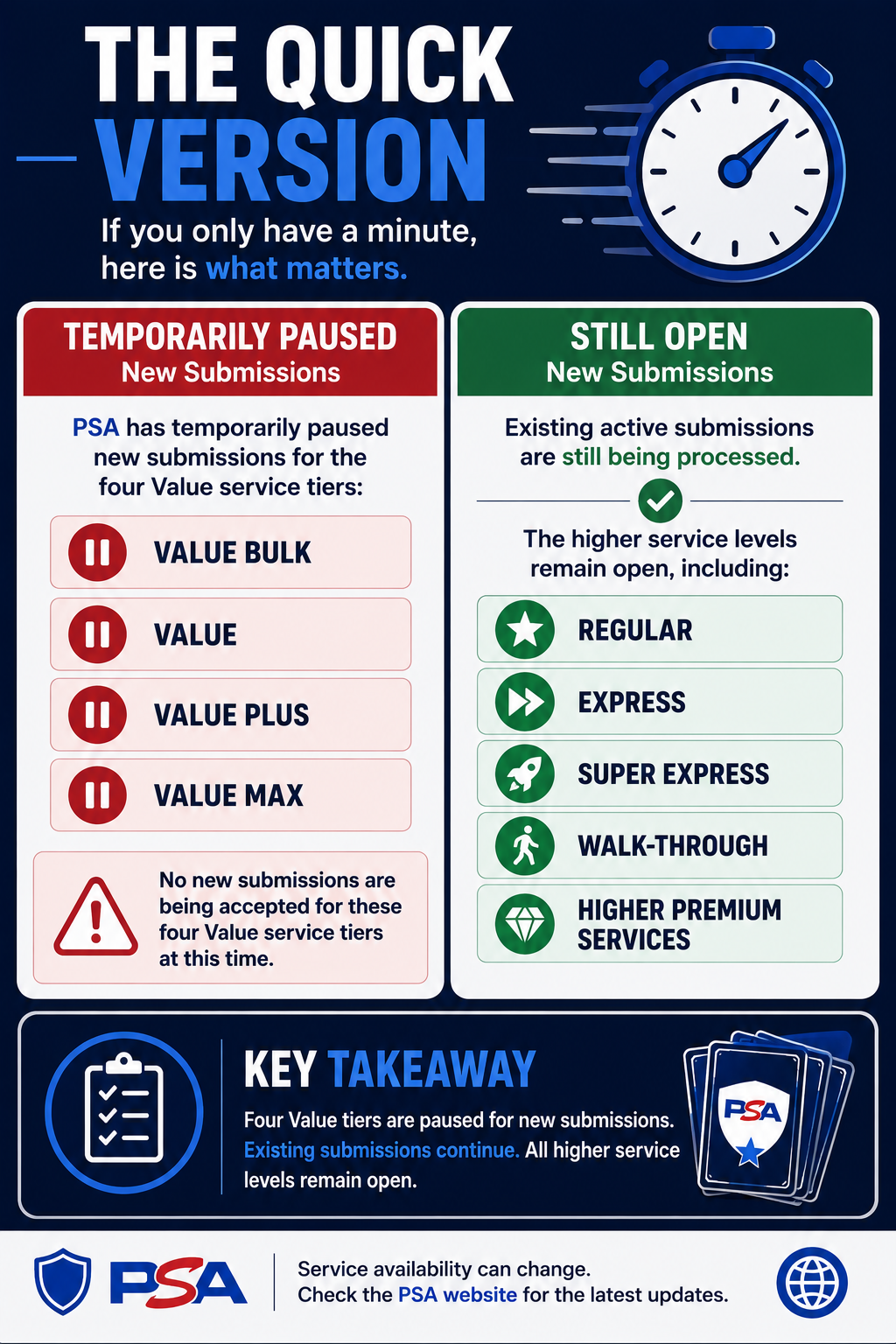
PSA has temporarily paused new submissions for the four Value service tiers:
- Value Bulk
- Value
- Value Plus
- Value Max
Existing active submissions are still being processed. The higher service levels remain open, including:
- Regular
- Express
- Super Express
- Walk-Through
- Higher Premium Services
PSA also temporarily extended Regular service turnaround expectations because the backlog affects the entire operational pipeline, from receiving through shipping.
That means the cheapest PSA grading options are off the table for now. When the cheapest lanes disappear, the math changes fast.
A card that made sense to grade at a lower bulk or value price may not make sense at a higher service tier. A modern card that only works if it gets a PSA 10 is now a much riskier submission. A card with a strong PSA 9 floor, a meaningful authentication need, a rare condition profile, or long-term personal value may still be a great candidate.
The collector takeaway is simple:
Do not ask, “Could this card gem?” Ask, “Does this card still make sense if it does not?”
What PSA Actually Changed
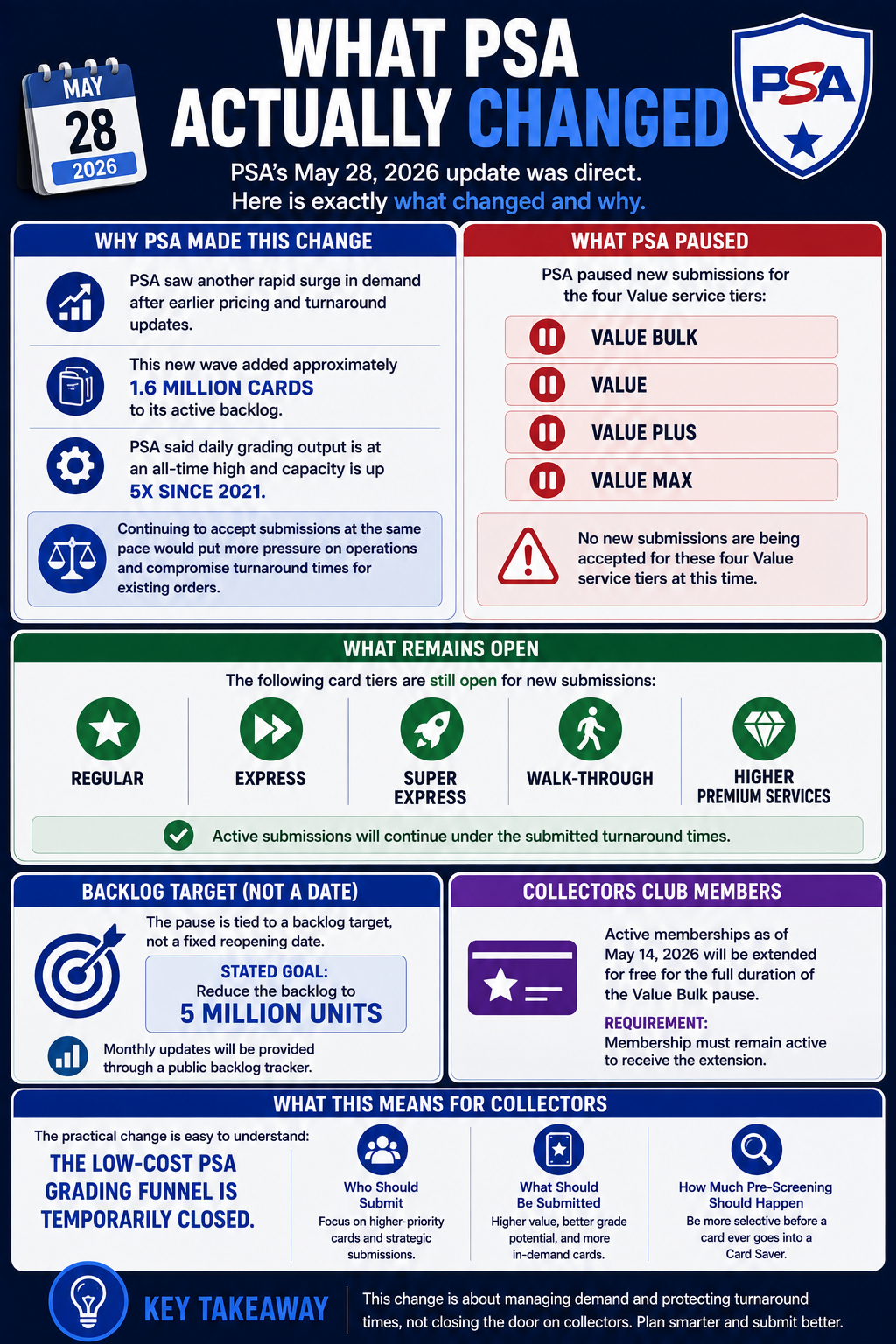
PSA’s May 28, 2026 update was direct. The company said it had seen another rapid surge in demand after earlier pricing and turnaround updates, and that the new wave added approximately 1.6 million cards to its active backlog.
PSA said daily grading output is at an all-time high and capacity is up five times since 2021, but that continuing to accept submissions at the same pace would put more pressure on operations and compromise turnaround times for existing orders.
So PSA paused new submissions for:
- Value Bulk
- Value
- Value Plus
- Value Max
The company said active submissions will continue under the submitted turnaround times, while the still-open card tiers include:
- Regular
- Express
- Super Express
- Walk-Through
- Higher Premium Services
PSA also said the pause is tied to a backlog target rather than a fixed reopening date. The stated goal is to reduce the backlog to about 5 million units, with monthly updates through a public backlog tracker.
For Collectors Club members, PSA said active memberships as of May 14, 2026 would be extended for free for the full duration of the Value Bulk pause, provided the membership remains active.
There is a lot packed into that update. But for collectors, the practical change is easy to understand:
The low-cost PSA grading funnel is temporarily closed.
That changes who should submit, what should be submitted, and how much pre-screening should happen before a card ever goes into a Card Saver.
This Is Not The First Grading Bottleneck, But It Feels Different
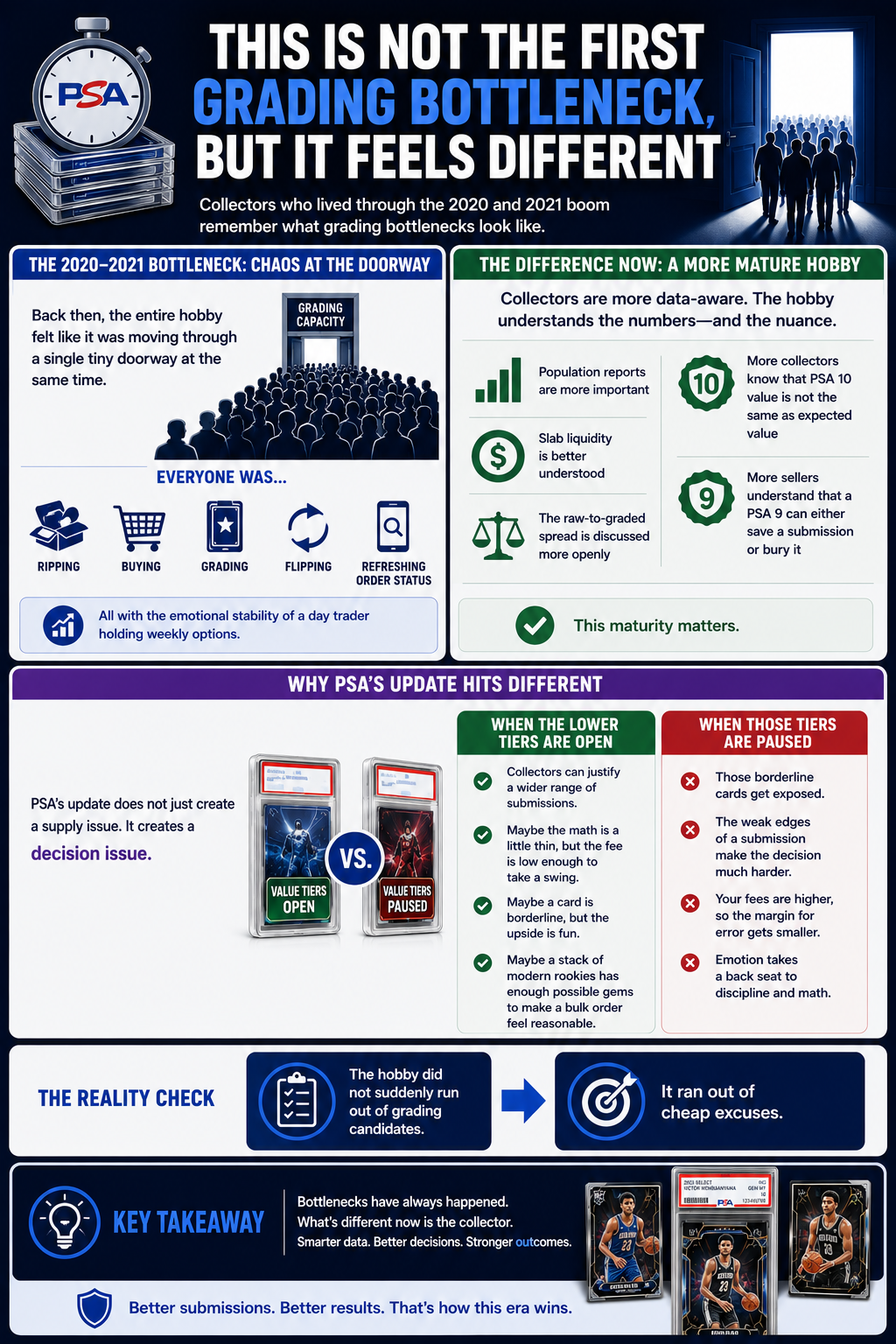
Collectors who lived through the 2020 and 2021 boom remember what grading bottlenecks look like. Back then, the entire hobby felt like it was moving through a single tiny doorway at the same time. Everyone was ripping, buying, grading, flipping, and refreshing order status pages with the emotional stability of a day trader holding weekly options.
The difference now is that the hobby is more mature.
Collectors are more data-aware. The population reports are more important. Slab liquidity is better understood. The raw-to-graded spread is discussed more openly. More collectors know that PSA 10 value is not the same as expected value. More sellers understand that a PSA 9 can either save a submission or bury it.
That maturity matters because PSA’s update does not just create a supply issue. It creates a decision issue.
When the lower tiers are open, collectors can justify a wider range of submissions. Maybe the math is a little thin, but the fee is low enough to take a swing. Maybe a card is borderline, but the upside is fun. Maybe a stack of modern rookies has enough possible gems to make a bulk order feel reasonable.
When those tiers are paused, those borderline cards get exposed.
The hobby did not suddenly run out of grading candidates. It ran out of cheap excuses.
The New Grading Math
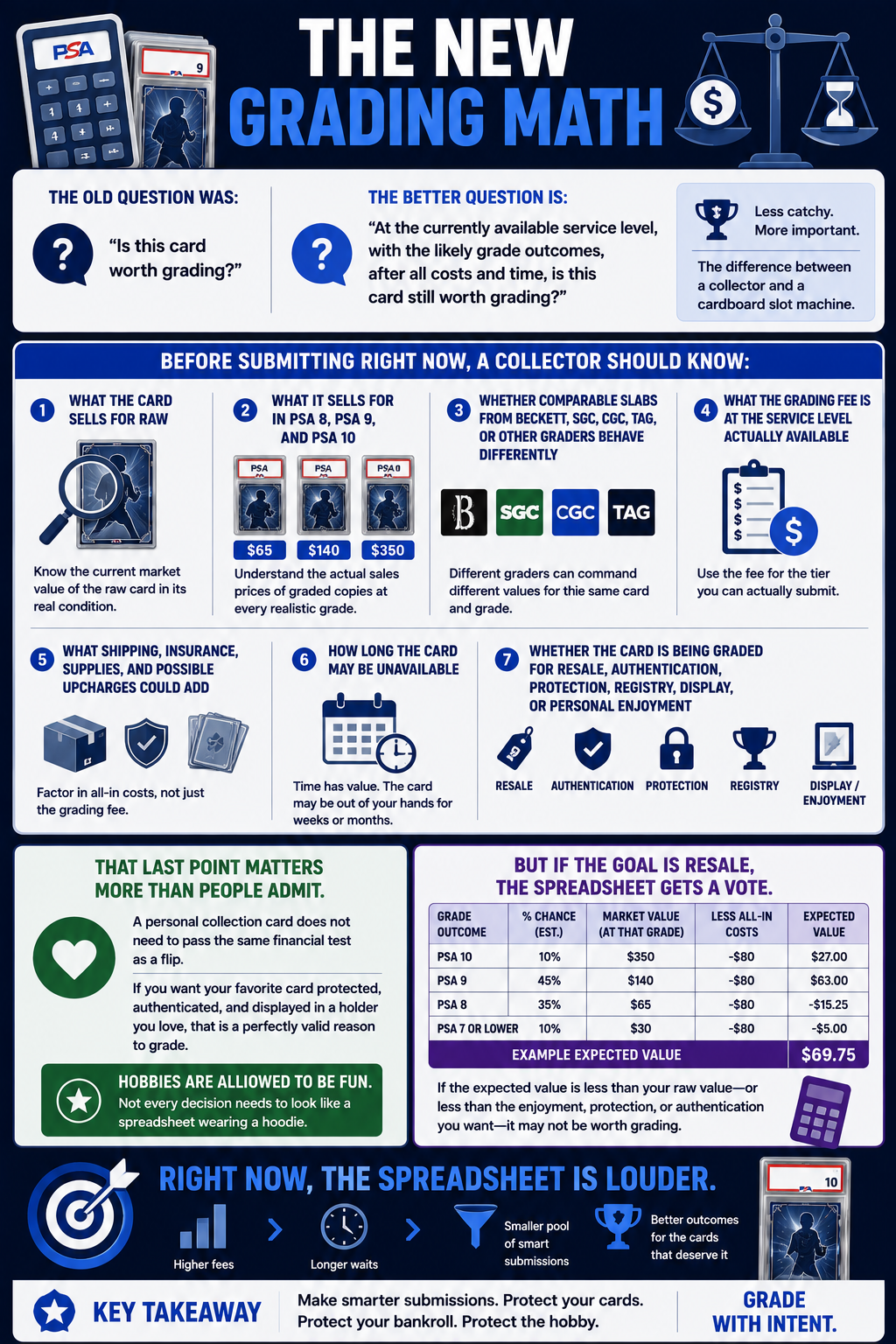
The old question was:
“Is this card worth grading?”
The better question is:
“At the currently available service level, with the likely grade outcomes, after all costs and time, is this card still worth grading?”
That question is less catchy. It is also the difference between a collector and a cardboard slot machine.
Before submitting right now, a collector should know:
- What The Card Sells For Raw
- What It Sells For In PSA 8, PSA 9, And PSA 10
- Whether Comparable Slabs From Beckett, SGC, CGC, TAG, Or Other Graders Behave Differently
- What The Grading Fee Is At The Service Level Actually Available
- What Shipping, Insurance, Supplies, And Possible Upcharges Could Add
- How Long The Card May Be Unavailable
- Whether The Card Is Being Graded For Resale, Authentication, Protection, Registry, Display, Or Personal Enjoyment
That last point matters more than people admit.
A personal collection card does not need to pass the same financial test as a flip. If you want your favorite card protected, authenticated, and displayed in a holder you love, that is a perfectly valid reason to grade. Hobbies are allowed to be fun. Not every decision needs to look like a spreadsheet wearing a hoodie.
But if the goal is resale, the spreadsheet gets a vote.
And right now, the spreadsheet is louder.
The Dangerous Trap: Grading Only For The 10
Every collector knows the daydream.
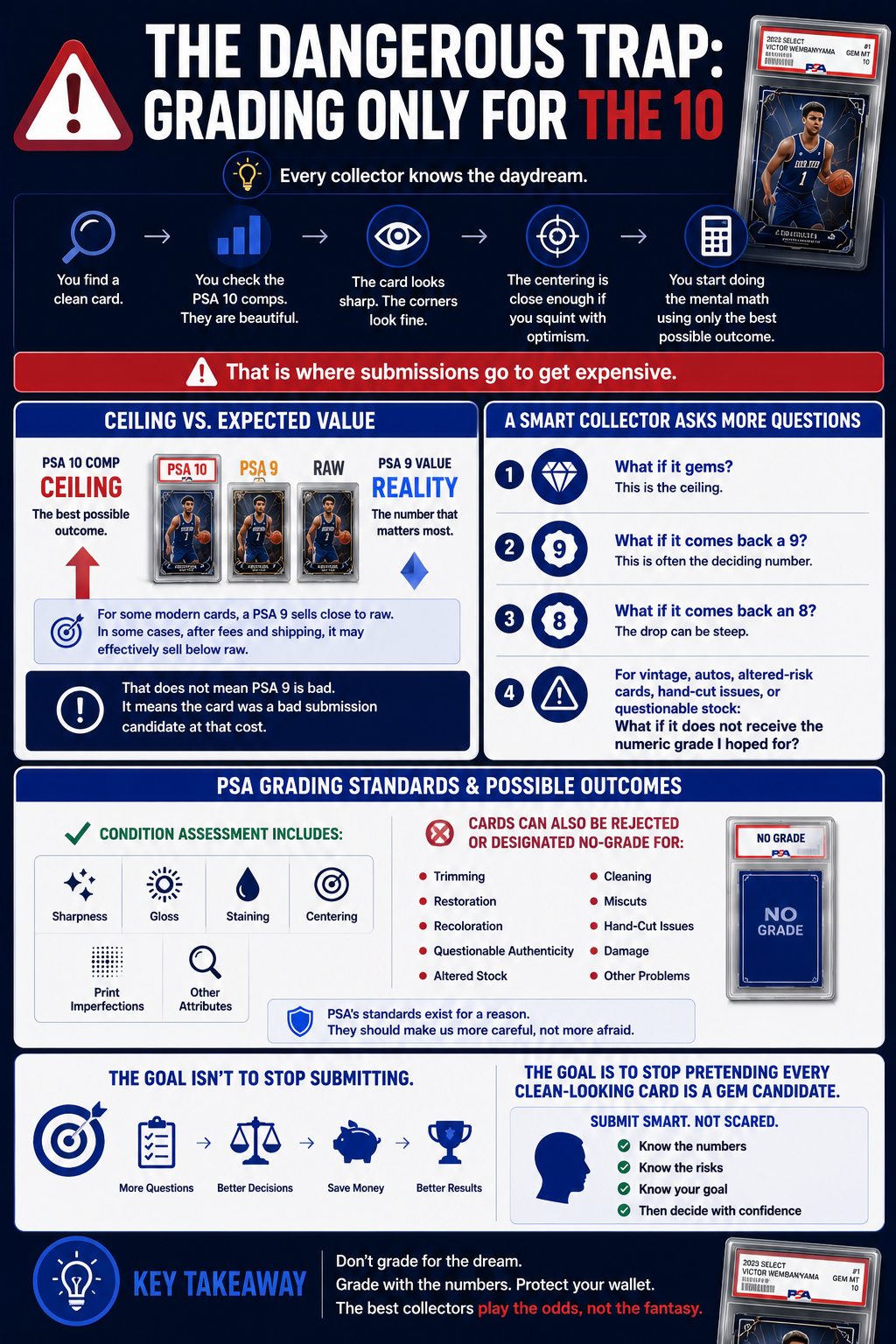
You find a clean card. You check the PSA 10 comps. They are beautiful. The card looks sharp. The corners look fine. The centering is close enough if you squint with optimism. You start doing the mental math using only the best possible outcome.
That is where submissions go to get expensive.
The PSA 10 comp is not the expected value. It is the ceiling. The more important number is often the PSA 9 value. For some modern cards, a PSA 9 sells close to raw. In some cases, after fees and shipping, it may effectively sell below raw.
That does not mean PSA 9 is bad. It means the card was a bad submission candidate at that cost.
A smart collector does not ask only, “What if it gems?”
A smart collector asks:
“What if it comes back a 9?”
Then:
“What if it comes back an 8?”
Then, for vintage, autos, altered-risk cards, hand-cut issues, or questionable stock:
“What if it does not receive the numeric grade I hoped for?”
PSA’s own grading standards make clear that condition assessment includes sharpness, gloss, staining, centering, print imperfections, and other attributes. Cards can also be rejected or designated no-grade for issues like trimming, restoration, recoloration, questionable authenticity, altered stock, cleaning, miscuts, and other problems.
That should make collectors more careful, not more afraid.
The goal is not to stop submitting. The goal is to stop pretending every clean-looking card is a gem candidate.
What Still Makes Sense To Grade?
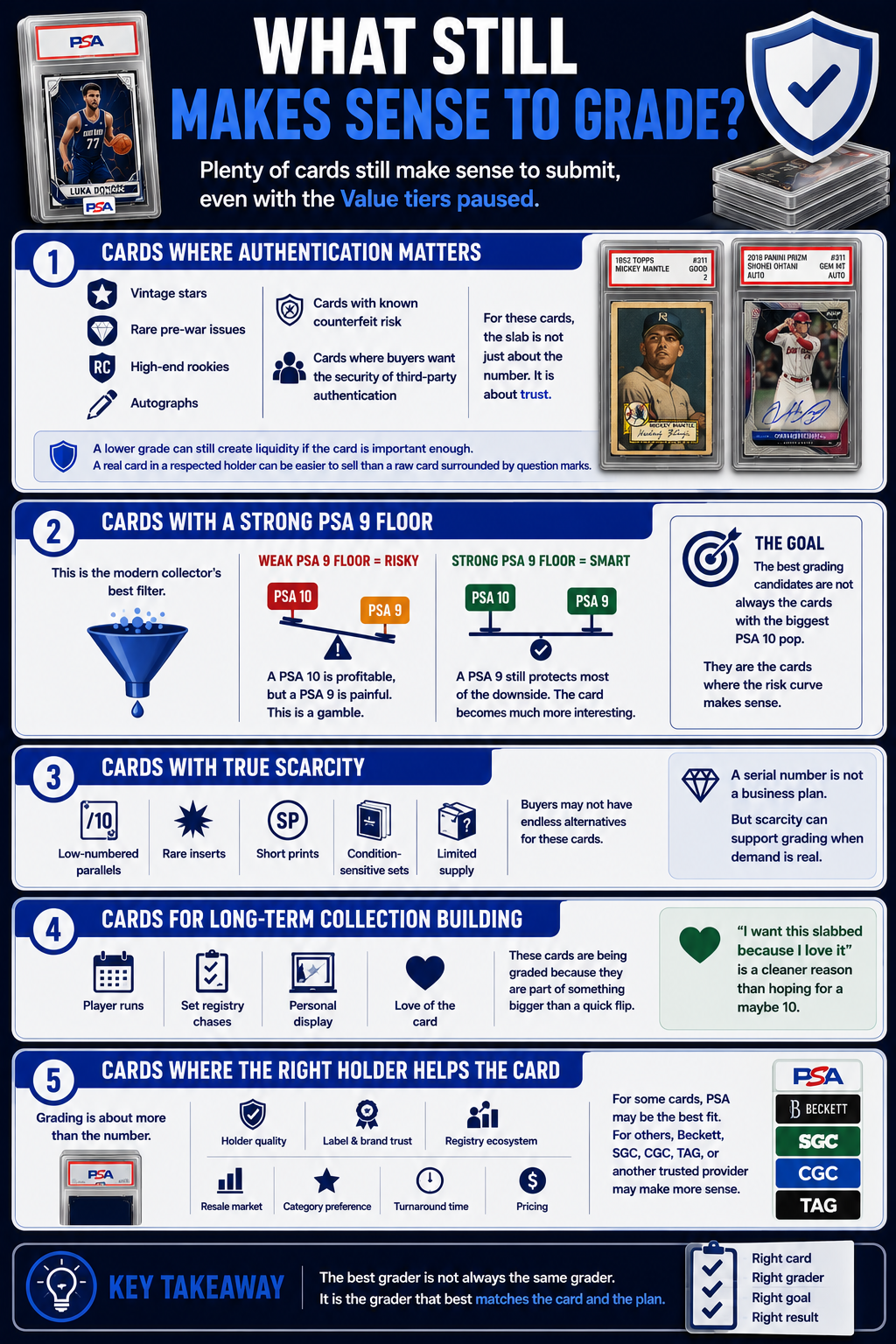
Plenty of cards still make sense to submit, even with the Value tiers paused.
The cards most likely to justify grading right now tend to fall into a few categories.
Cards Where Authentication Matters
Vintage stars. Rare pre-war issues. High-end rookies. Autographs. Cards with known counterfeit risk. Cards where buyers want the security of third-party authentication.
For these cards, the slab is not just about the number. It is about trust.
A lower grade can still create liquidity if the card is important enough. A real card in a respected holder can be easier to sell than a raw card surrounded by question marks.
Cards With A Strong PSA 9 Floor
This is the modern collector’s best filter.
If a PSA 10 is profitable but a PSA 9 is painful, the submission is a gamble. If a PSA 9 still protects most of the downside, the card becomes much more interesting.
The best grading candidates are not always the cards with the biggest PSA 10 pop. They are the cards where the risk curve makes sense.
Cards With True Scarcity
Low-numbered parallels, rare inserts, short prints, condition-sensitive sets, and cards with limited supply can still make sense because buyers may not have endless alternatives.
This does not mean every numbered card should be graded. A serial number is not a business plan. But scarcity can support grading when demand is real.
Cards For Long-Term Collection Building
Some cards are not being graded to flip next week. They are being graded because they are part of a long-term collection, a player run, a set registry chase, or a personal display.
That is different math, and it is valid.
The key is being honest about the goal. “I want this slabbed because I love it” is a cleaner reason than “I think this base rookie might maybe 10 and then maybe someone will pay a premium.”
Cards Where The Right Holder Helps The Card
Collectors sometimes talk as if grading is only about the number. It is not. The holder, label, brand trust, registry ecosystem, resale market, and category-specific collector preference all matter.
For some cards, PSA may be the best fit. For others, Beckett, SGC, CGC, TAG, or another trusted provider may make more sense depending on category, condition, aesthetics, turnaround time, pricing, and the collector’s goal.
The best grader is not always the same grader. It is the grader that best matches the card and the plan.
What Probably Does Not Make Sense Right Now?
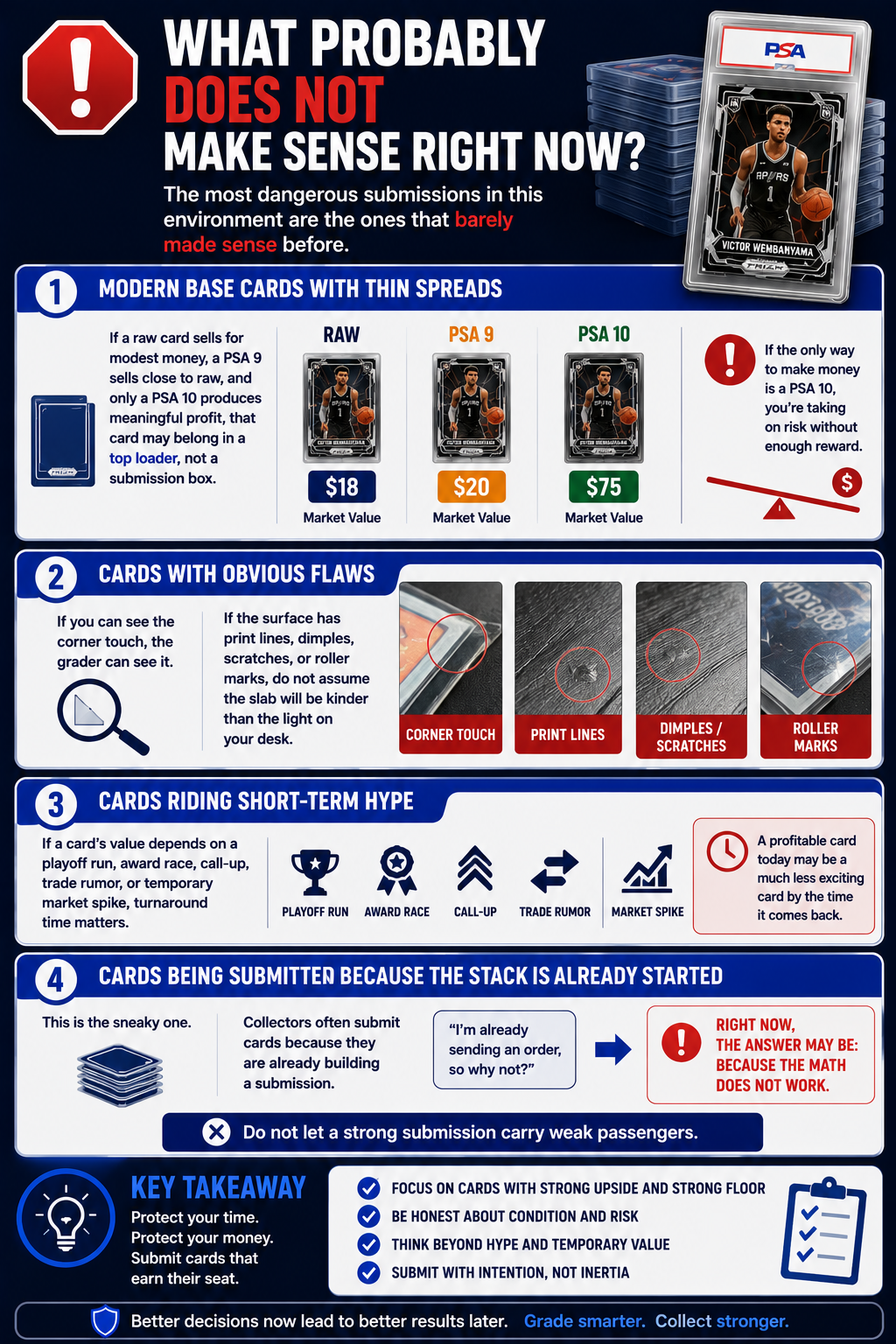
The most dangerous submissions in this environment are the ones that barely made sense before.
Modern Base Cards With Thin Spreads
If a raw card sells for modest money, a PSA 9 sells close to raw, and only a PSA 10 produces meaningful profit, that card may belong in a top loader, not a submission box.
Cards With Obvious Flaws
If you can see the corner touch, the grader can see it. If the surface has print lines, dimples, scratches, or roller marks, do not assume the slab will be kinder than the light on your desk.
Cards Riding Short-Term Hype
If a card’s value depends on a playoff run, award race, call-up, trade rumor, or temporary market spike, turnaround time matters. A profitable card today may be a much less exciting card by the time it comes back.
Cards Being Submitted Because The Stack Is Already Started
This is the sneaky one.
Collectors often submit cards because they are already building a submission. Once the pile exists, marginal cards start sneaking in. The logic becomes, “I’m already sending an order, so why not?”
Right now, the answer may be: because the math does not work.
Do not let a strong submission carry weak passengers.
How Consolidation Fits Into All Of This
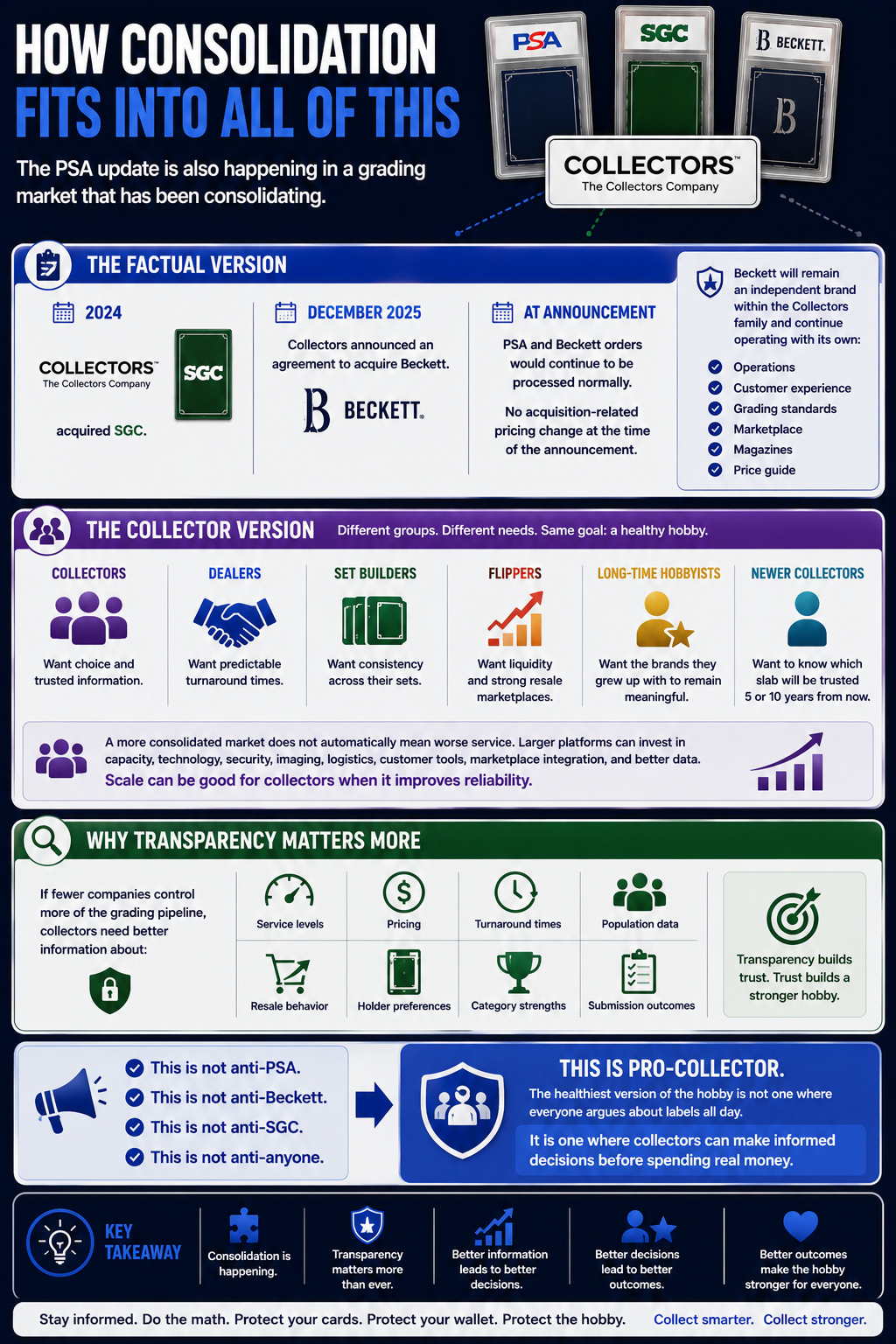
The PSA update is also happening in a grading market that has been consolidating.
Collectors, the parent company of PSA, acquired SGC in 2024. In December 2025, Collectors announced an agreement to acquire Beckett, stating that Beckett would remain an independent brand within the Collectors family and continue operating with its own operations, customer experience, grading standards, marketplace, magazines, and price guide.
Collectors also said PSA and Beckett orders would continue to be processed normally, with no acquisition-related pricing change at the time of the announcement.
That is the factual version.
The collector version is more complicated.
Collectors want choice. Dealers want predictable turnaround times. Set builders want consistency. Flippers want liquidity. Long-time hobbyists want the brands they grew up with to remain meaningful. Newer collectors want to know which slab will be trusted five or ten years from now.
A more consolidated market does not automatically mean worse service. Larger platforms can invest in capacity, technology, security, imaging, logistics, customer tools, marketplace integration, and better data. Scale can be good for collectors when it improves reliability.
But consolidation does make transparency more important.
If fewer companies control more of the grading pipeline, collectors need better information about service levels, pricing, turnaround times, population data, resale behavior, holder preferences, category strengths, and submission outcomes.
That is not anti-PSA. It is not anti-Beckett. It is not anti-SGC. It is not anti-anyone.
It is pro-collector.
The healthiest version of the hobby is not one where everyone argues about labels all day. It is one where collectors can make informed decisions before spending real money.
The Grading Company Debate Needs To Grow Up
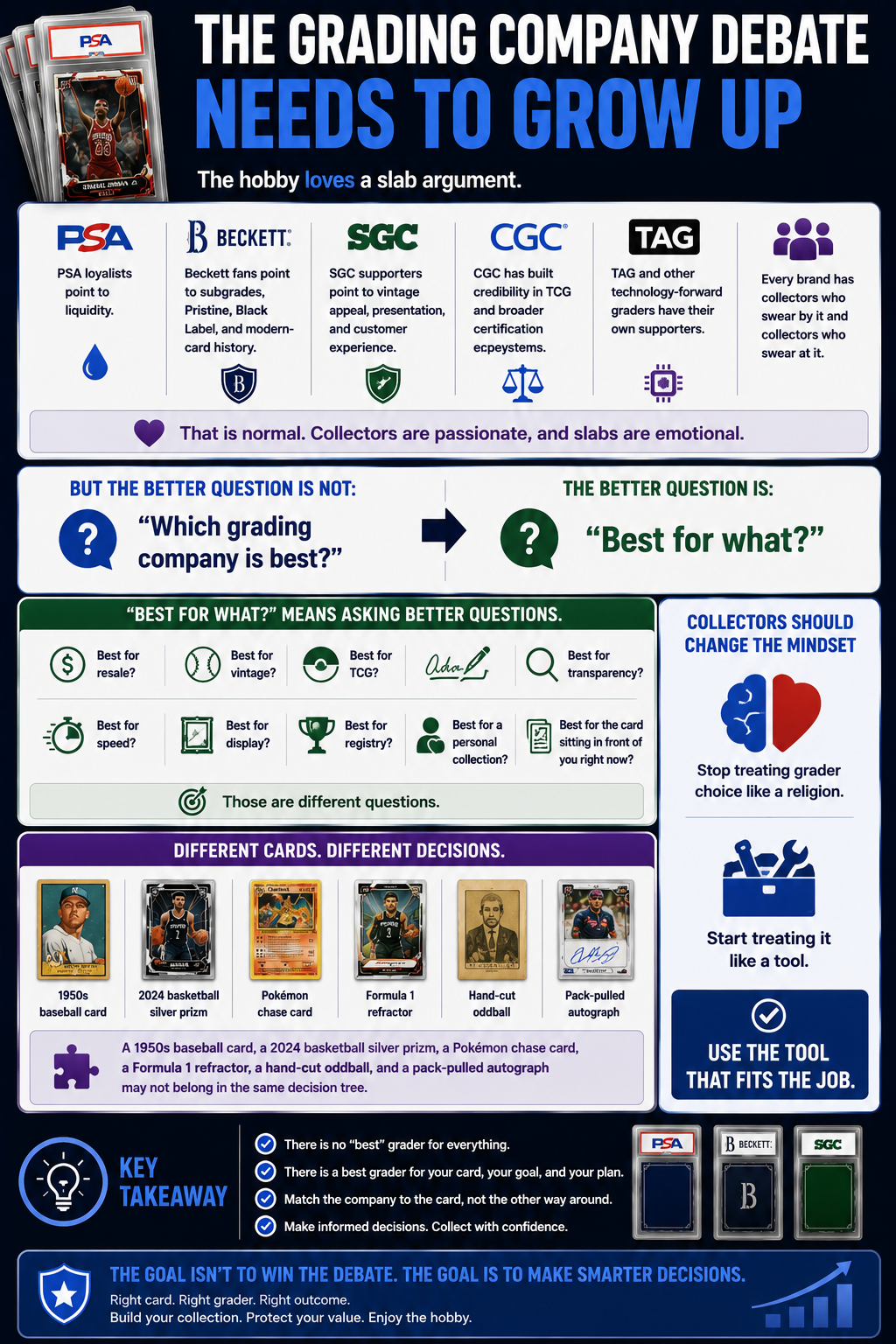
The hobby loves a slab argument.
PSA loyalists point to liquidity. Beckett fans point to subgrades, Pristine, Black Label, and modern-card history. SGC supporters point to vintage appeal, presentation, and customer experience. CGC has built credibility in TCG and broader certification ecosystems. TAG and other technology-forward graders have their own supporters. Every brand has collectors who swear by it and collectors who swear at it.
That is normal. Collectors are passionate, and slabs are emotional.
But the better question is not “Which grading company is best?”
The better question is:
“Best for what?”
Best for resale?
Best for vintage?
Best for TCG?
Best for autos?
Best for transparency?
Best for speed?
Best for display?
Best for registry?
Best for a personal collection?
Best for the card sitting in front of you right now?
Those are different questions.
A 1950s baseball card, a 2024 basketball silver prizm, a Pokémon chase card, a Formula 1 refractor, a hand-cut oddball, and a pack-pulled autograph may not belong in the same decision tree.
Collectors should stop treating grader choice like a religion and start treating it like a tool.
Use the tool that fits the job.
A Better Submission Checklist
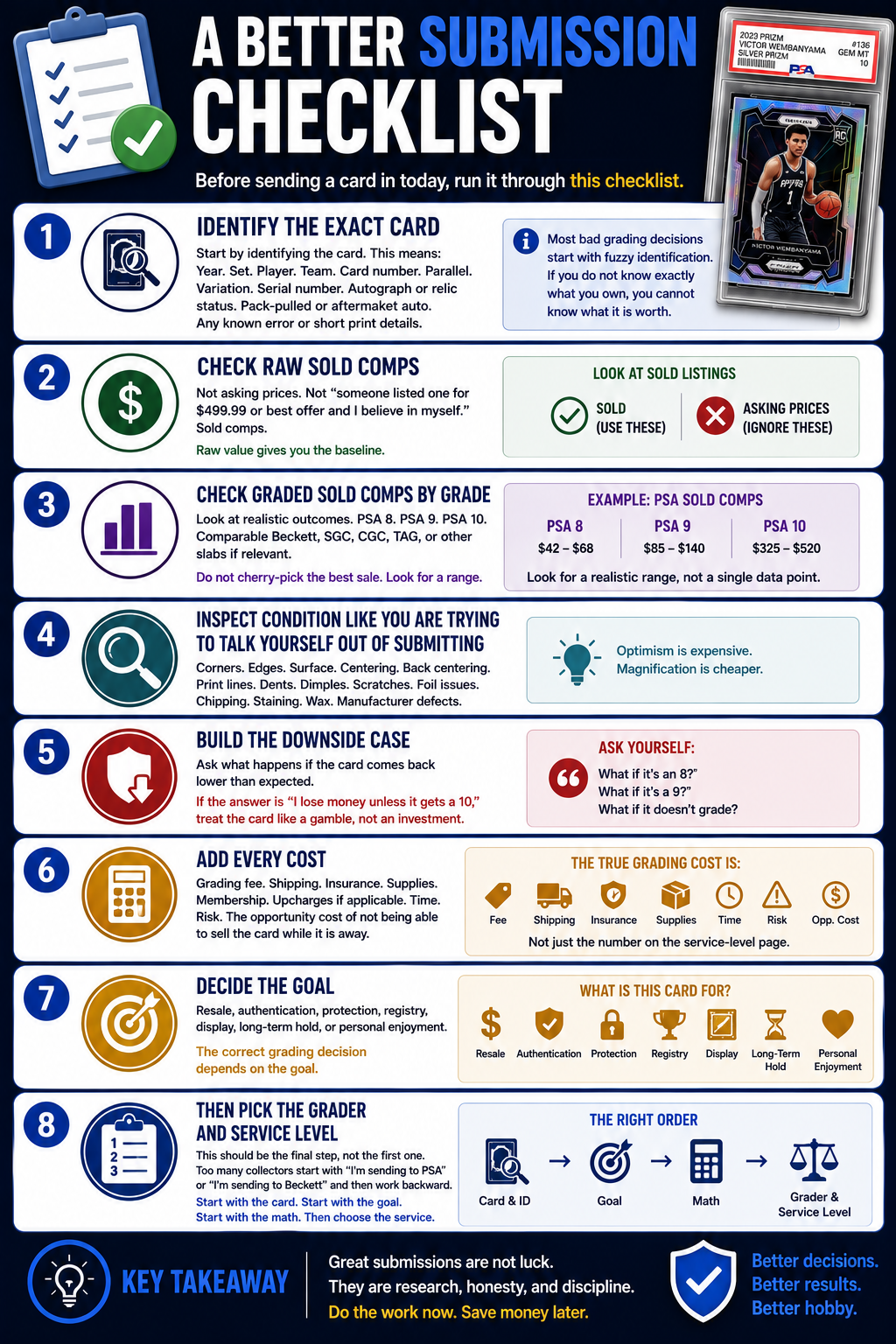
Before sending a card in today, run it through this checklist.
Identify The Exact Card
Start by identifying the card. This means: Year. Set. Player. Team. Card number. Parallel. Variation. Serial number. Autograph or relic status. Pack-pulled or aftermarket auto. Any known error or short print details.
Most bad grading decisions start with fuzzy identification. If you do not know exactly what you own, you cannot know what it is worth.
Check Raw Sold Comps
Not asking prices. Not “someone listed one for $499.99 or best offer and I believe in myself.” Sold comps.
Raw value gives you the baseline.
Check Graded Sold Comps By Grade
Look at realistic outcomes. PSA 8. PSA 9. PSA 10. Comparable Beckett, SGC, CGC, TAG, or other slabs if relevant.
Do not cherry-pick the best sale. Look for a range.
Inspect Condition Like You Are Trying To Talk Yourself Out Of Submitting
Corners. Edges. Surface. Centering. Back centering. Print lines. Dents. Dimples. Scratches. Foil issues. Chipping. Staining. Wax. Manufacturer defects.
Optimism is expensive. Magnification is cheaper.
Build The Downside Case
Ask what happens if the card comes back lower than expected.
If the answer is “I lose money unless it gets a 10,” treat the card like a gamble, not an investment.
Add Every Cost
Grading fee. Shipping. Insurance. Supplies. Membership. Upcharges if applicable. Time. Risk. The opportunity cost of not being able to sell the card while it is away.
The true grading cost is not just the number on the service-level page.
Decide The Goal
Resale, authentication, protection, registry, display, long-term hold, or personal enjoyment.
The correct grading decision depends on the goal.
Then Pick The Grader And Service Level
This should be the final step, not the first one.
Too many collectors start with “I’m sending to PSA” or “I’m sending to Beckett” and then work backward. Start with the card. Start with the goal. Start with the math. Then choose the service.
The Collector Mindset Shift
For years, a lot of the hobby operated on submission volume. Find enough candidates, send enough cards, hope enough gems pay for the misses.
That still works for some people, especially experienced submitters with strong sourcing, sharp condition screening, and real market discipline.
But for casual collectors, the Value tier pause is a reminder that grading is not magic. It is a paid service with a cost, a queue, a standard, and an uncertain outcome.
The collectors who adapt best will be the ones who become more selective.
They will grade fewer bad candidates. They will keep more cards raw when raw makes sense. They will use different grading companies when different grading companies make sense. They will think about liquidity before they submit. They will know their downside. They will stop treating the PSA 10 comp as destiny.
They will still enjoy the hobby.
In fact, they may enjoy it more.
There is a strange freedom in not needing every card to become a slab. Some trading cards are better raw. Some cards are better sold. Some cards are better protected in a binder, displayed in a one-touch, or kept because they remind you why you started collecting in the first place.
The slab should serve the collection.
The collection should not serve the slab.
Where CardWiki Fits
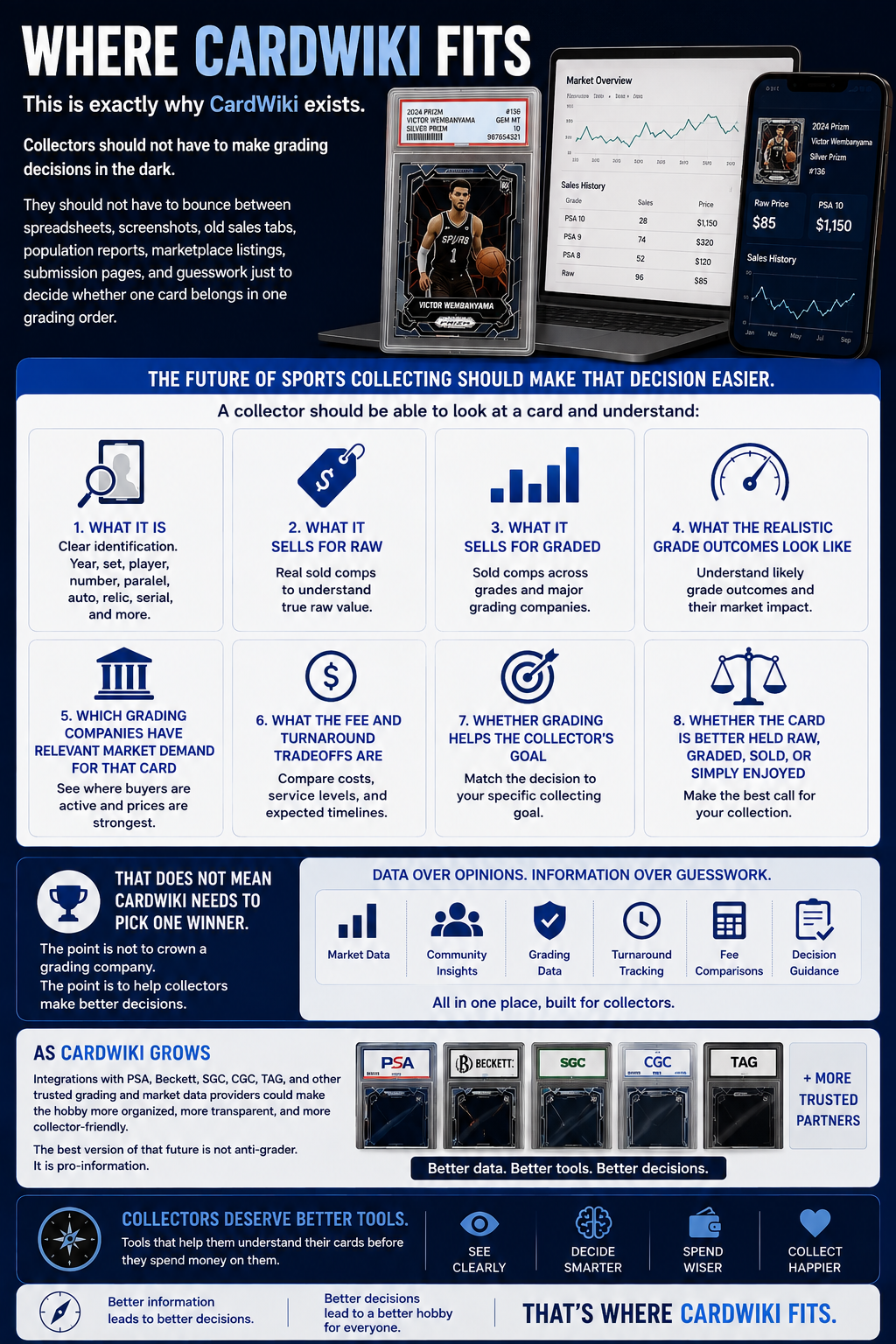
This is exactly why CardWiki exists.
Collectors should not have to make grading decisions in the dark. They should not have to bounce between spreadsheets, screenshots, old sales tabs, population reports, marketplace listings, submission pages, and guesswork just to decide whether one card belongs in one grading order.
The future of sports collecting should make that decision easier.
A collector should be able to look at a card and understand:
- What It Is
- What It Sells For Raw
- What It Sells For Graded
- What The Realistic Grade Outcomes Look Like
- Which Grading Companies Have Relevant Market Demand For That Card
- What The Fee And Turnaround Tradeoffs Are
- Whether Grading Helps The Collector’s Goal
- Whether The Card Is Better Held Raw, Graded, Sold, Or Simply Enjoyed
That does not mean CardWiki needs to pick one winner. The point is not to crown a grading company. The point is to help collectors make better decisions.
As CardWiki grows, integrations with PSA, Beckett, SGC, CGC, TAG, and other trusted grading and market data providers could make the hobby more organized, more transparent, and more collector-friendly. The best version of that future is not anti-grader. It is pro-information.
Collectors deserve tools that help them understand their cards before they spend money on them.
Bottom Line
PSA’s Value tier pause is a big deal, but it is not a reason to panic.
It is a reason to think.
PSA is still grading cards. Higher service levels remain open. Existing submissions are still moving. The paused Value tiers are expected to return when PSA hits its backlog goals. But for now, the lower-cost PSA submission path is temporarily unavailable, and that changes the economics for a lot of cards.
So the best collector move is not outrage. It is discipline.
Grade the cards that deserve it. Hold the cards that do not. Compare raw and graded outcomes. Respect the PSA 9. Respect the downside. Choose the grading company that fits the card and the goal. Do not let hype, habit, or hope make the decision for you.
The hobby is better when collectors have more information, more transparency, and more confidence.
And right now, the smartest submission is not the biggest one.