
Upper Deck Hockey Releases Explained: Series 1, Series 2, Extended Series, Young Guns, and Canvas
earn how Upper Deck Series 1, Series 2, Extended Series, Young Guns, and UD Canvas fit together across the flagship hockey card checklist for collectors.
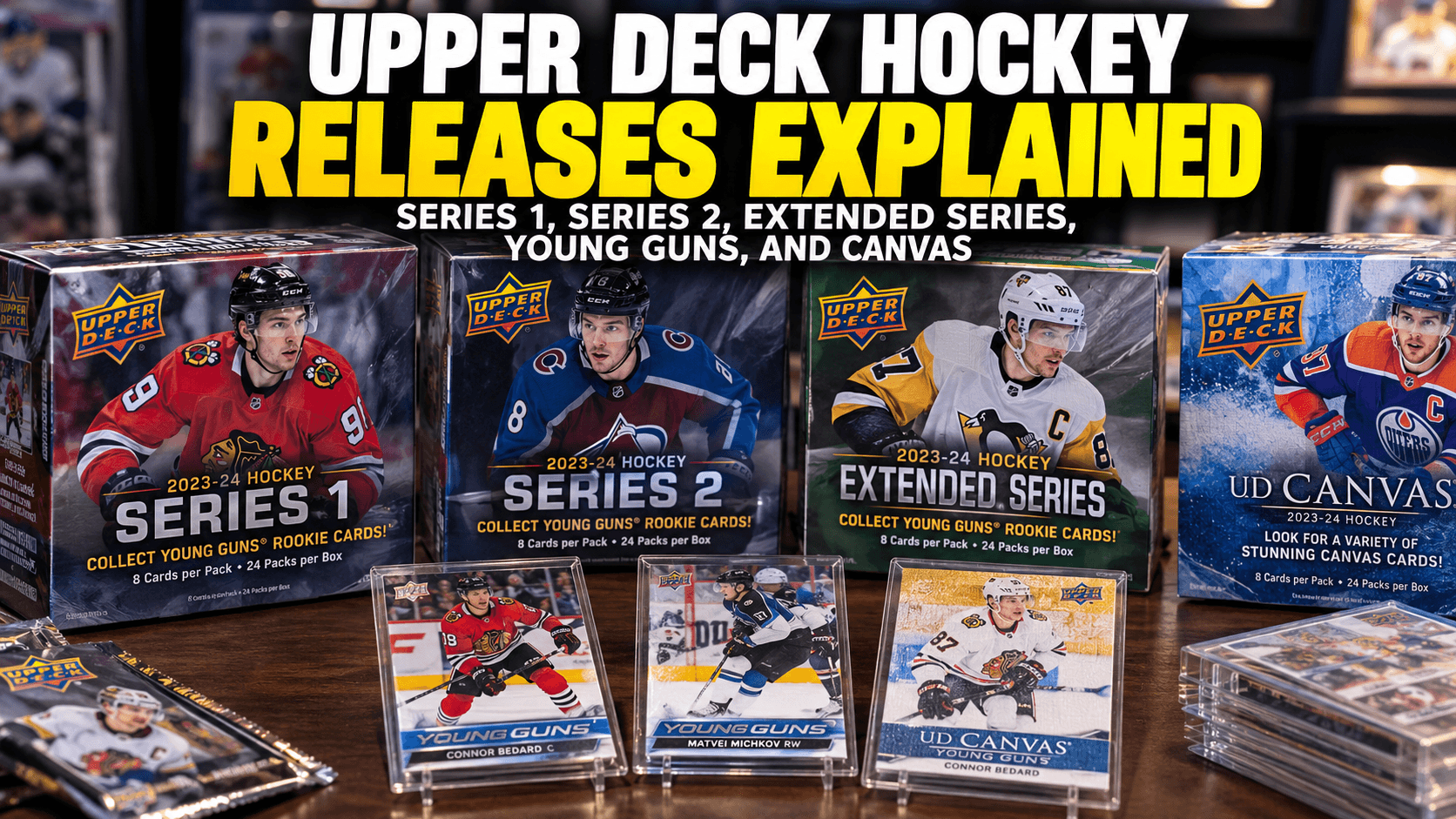
Upper Deck flagship hockey can look confusing at first because the annual card checklist is spread across several releases, while rookie cards, inserts, parallels, Canvas cards, and special versions all appear within that larger structure.
The simple version is this: Upper Deck Series 1 starts the annual flagship hockey set, Series 2 continues it, and Extended Series carries the flagship checklist further. Young Guns are the signature rookie portion of the flagship base set, while UD Canvas is a separate insert family that can include Canvas Young Guns.
Understanding those relationships makes it much easier to identify what you actually have.
Collectors who are still getting familiar with release terminology should start with our broader guide to how trading card releases work, which explains concepts such as Series 1, Series 2, Update, Extended, Chrome, and Draft across the hobby.
How Do Upper Deck Hockey Releases Work?
Upper Deck does not necessarily release its entire annual flagship hockey checklist in one product at one time.
Instead, the flagship set is divided across several releases.
The modern structure commonly includes:
- Upper Deck Series 1
- Upper Deck Series 2
- Upper Deck Extended Series
Each release contributes another portion of the larger annual flagship checklist.
That is important because Series 1 and Series 2 are not simply competing versions of the same cards. They contain different card numbers, different players, different Young Guns, and different portions of the annual set.
Extended Series carries that structure further.
If you are unsure how a release differs from a set or checklist, our guide explaining what a card set is and how releases actually work provides the basic framework.
Upper Deck Flagship Release Chart
| Release | Main Role | Checklist Role | Rookie Content | Other Common Content |
|---|---|---|---|---|
| Series 1 | Opens the flagship season | First portion of the base checklist | Young Guns | UD Canvas, inserts, parallels |
| Series 2 | Continues flagship | Next portion of the base checklist | Additional Young Guns | UD Canvas, inserts, parallels |
| Extended Series | Extends the flagship set | Later portion of the base checklist | Additional rookie content | Canvas, parallels, retro concepts, inserts |
| UD Canvas | Separate insert family | Separate numbered checklist | Canvas Young Guns | Veterans, legends, special subsets |
| Young Guns | Rookie subset of flagship base set | Appears within base numbering | Rookie cards | Parallel versions may also exist |
The exact checklist structure, parallel lineup, insert lineup, odds, and box configuration can change from season to season.
That is why collectors should always check the product year rather than assuming every Upper Deck hockey release works exactly like the previous one.
What Is Upper Deck Series 1 Hockey?
Upper Deck Series 1 is the opening installment of Upper Deck's annual flagship hockey set.
It introduces the flagship design for the season and begins the annual base checklist.
Series 1 generally contains:
- Veteran base cards
- Young Guns rookie cards
- Checklist cards
- UD Canvas cards
- Insert sets
- Base parallels
- Young Guns parallels
- Other release-specific chase cards
Series 1 gets significant collector attention because it begins the flagship collecting year and contains the first major Young Guns group of the season.
That does not mean every major rookie will appear in Series 1.
Young Guns placement depends on the player, NHL timing, eligibility, checklist construction, and Upper Deck's release schedule.
A rookie who does not appear in Series 1 may appear later in Series 2 or Extended Series.
What Is Upper Deck Series 2 Hockey?
Upper Deck Series 2 continues the annual flagship checklist that began with Series 1.
It does not replace Series 1.
Instead, it gives collectors the next group of base cards, Young Guns, Canvas cards, inserts, and parallels.
For set builders, Series 2 is part of completing the larger annual flagship set.
For rookie collectors, it creates another major Young Guns chase.
This is why the question "Is Series 1 or Series 2 better?" does not have a universal answer.
Collector interest often depends heavily on the rookie checklist.
One season may have an especially strong Series 1 rookie class, while another may generate more attention around Series 2.
Upper Deck Series 1 Vs Series 2
The main difference between Upper Deck Series 1 and Series 2 is which portion of the flagship checklist each release contains.
They belong to the same larger annual flagship structure but contain different cards.
| Feature | Series 1 | Series 2 |
|---|---|---|
| Flagship role | Opens the annual set | Continues the annual set |
| Base checklist | First card-number range | Next card-number range |
| Young Guns | First major rookie group | Additional rookie group |
| UD Canvas | First portion of Canvas content | Continues Canvas content |
| Inserts | Mix of flagship insert sets | Continuing and additional insert sets |
| Parallels | Base and Young Guns parallels | Base and Young Guns parallels |
| Set-building role | Starts the flagship collection | Continues the collection |
Neither release name automatically makes one card more desirable than another.
The player, rookie status, card version, scarcity, condition, collector demand, and specific checklist all matter.
That same principle applies across trading cards. Our article on why some trading cards are valuable and others are not explains why scarcity alone does not determine value.
What Is Upper Deck Extended Series?
Upper Deck Extended Series is a continuation of the annual flagship hockey structure that carries the base checklist beyond Series 1 and Series 2.
It gives Upper Deck room to add more players, additional rookie content, later-season cards, continuing inserts, parallels, and other flagship concepts.
Collectors sometimes make the mistake of assuming that Series 2 automatically represents the end of the flagship checklist.
Extended Series shows why that assumption can cause identification problems.
Depending on the year, Extended Series can contain:
- Additional veteran base cards
- Additional Young Guns
- Other rookie subsets
- Flagship parallels
- Additional UD Canvas cards
- Continuing insert checklists
- Retro-themed cards
- Later-season player additions
- Extended-specific inserts
Extended Series should be viewed as part of the broader Upper Deck flagship ecosystem rather than as an unrelated hockey brand.
The exact structure still needs to be checked against the official checklist for the specific season.
Why Are Checklists So Important With Upper Deck Hockey?
Upper Deck hockey is a great example of why collectors should learn how to use a checklist.
A checklist tells you where a card belongs within the larger product structure.
It can help determine:
- Whether the card is Series 1, Series 2, or Extended
- Whether it belongs to the base set or an insert set
- Whether the player is part of the Young Guns checklist
- Whether a card number belongs to UD Canvas
- Whether the card is a parallel
- Whether a serial-numbered version exists
- Whether similar-looking cards are actually different releases
Our guide to trading card checklists explains how collectors can use checklist information to identify cards more accurately.
What Are Young Guns Cards?
Young Guns are Upper Deck's flagship rookie cards and one of the most recognized rookie-card formats in modern hockey collecting.
Standard Young Guns belong to the flagship base set.
That point is important.
A standard Young Guns card is not simply a random rookie insert placed alongside the base checklist. It occupies its own defined rookie portion of the flagship base set.
If you are still learning how rookie terminology works across the hobby, CardWiki's guide to what a rookie card is explains the broader concept.
Young Guns can appear throughout the flagship release schedule.
A player may have a Young Guns card in:
- Series 1
- Series 2
- Extended Series
The release containing the card is part of the card's identity.
Calling a card simply "an Upper Deck Young Guns" may not be specific enough for accurate cataloging.
A complete identity may require:
- Product year
- Manufacturer
- Release
- Set
- Player
- Card number
- Rookie status
- Parallel
- Finish
- Serial number
- Variation
- Configuration
CardWiki's guide on how to identify a trading card explains why those details matter.
Is A Canvas Young Guns Card The Same As A Regular Young Guns Card?
No.
A standard Young Guns card and a UD Canvas Young Guns card are separate cards.
The standard Young Guns card belongs to the flagship base checklist.
The Canvas Young Guns belongs to the separate UD Canvas checklist.
A rookie can appear in both, but that does not make the two cards interchangeable.
They can differ in:
- Card number
- Photography
- Design
- Card stock
- Surface treatment
- Checklist placement
- Pack odds
- Parallel structure
UD Canvas cards commonly use their own numbering system, which makes the card number an especially useful identification clue.
Collectors trying to determine the exact set should also review our guide on how to tell what set a trading card is from.
What Is UD Canvas?
UD Canvas is a recurring Upper Deck insert family featuring a separate checklist and a canvas-style card treatment.
The checklist can include veterans, stars, rookies, legends, and other themed subjects depending on the season.
Canvas Young Guns are rookie cards within that Canvas family.
This means Canvas should not automatically be treated as another word for parallel.
That is one of the most common terminology problems new collectors encounter.
An insert is a separate card set placed inside a larger product.
A parallel is an alternate version of an existing card.
For a deeper explanation of those categories, see:
Those concepts are especially helpful when identifying Upper Deck hockey because similar player images can appear across several related card families.
Young Guns Vs Canvas Young Guns Vs Parallels
| Card Type | Base Set? | Separate Checklist? | Same As Standard Young Guns? | Can Have Additional Versions? |
|---|---|---|---|---|
| Standard Young Guns | Yes | Part of flagship base checklist | Standard rookie card | Yes |
| Canvas Young Guns | No | Yes, UD Canvas | No | Yes |
| Young Guns Exclusives | Underlying base Young Guns | Parallel relationship | No, parallel version | It is already a parallel |
| Young Guns High Gloss | Underlying base Young Guns | Parallel relationship | No, parallel version | It is already a parallel |
| Young Guns Outburst | Underlying base Young Guns | Parallel relationship | No, parallel version | It is already a parallel |
| Separate rookie insert | No | Usually | No | Depends on insert family |
The player's name is only one piece of the identity.
Two cards can feature the same player from the same season and still be entirely separate checklist entries.
How Do Young Guns Parallels Work?
A Young Guns parallel is an alternate version of the underlying Young Guns card.
The parallel relationship generally preserves important base characteristics such as:
- Player
- Product year
- Release
- Card number
- Core card design
- Rookie relationship
It then changes another attribute, which could include:
- Color
- Finish
- Surface treatment
- Material
- Serial numbering
- Print quantity
- Distribution method
Upper Deck has used Young Guns parallel names such as Exclusives, High Gloss, Clear Cut, Outburst, Deluxe, and other season-specific treatments.
The available parallels change over


